Donate
Diocese of Leeds Justice and Peace Commission (1)

July 2025 Newsletter

📄 Download PDF Newsletter

26 June – St Vincent’s Centre Leeds Welcomes Refugees 

By John Battle, Commission Chair 

It's again peak channel crossing time for small boats carrying desperate asylum seekers from the coast of France. This week violence broke out just offshore between rival groups of Kurdish, Afghani and African smugglers in attempts to take over leaving boats. Reports of "overwhelming numbers" dominate media coverage. 

Internationally, here nationally and locally the Catholic Church has a long, highly respected and valued contribution to supporting migrants, asylum seekers and refugees. In 2004 The Vatican published "The Love of Christ Towards Migrants" stressing the "ministry of welcome". In 2006 our Catholic Bishops issued "Mission of the Church to Migrants" opening with the words  

"Across the country in all our Dioceses we have migrants from nearly every continent in the world adding people and vibrancy to our parishes. We the Bishops are calling for a more visible culture of welcome hospitality and solidarity with our migrant sisters and brothers". 

herts story In 2016 our Diocesan Justice and Peace Commission produced "Welcome the Stranger", a handbook of what that means in practice.  Bishop Marcus contributed an encouraging spiritual introduction.

With Catholic Care, the Commission set up what has become the St Monica's Housing Trust - two houses providing support and refuge for single asylum-seeking women "with no access to public funds".

More recently the Catholic bishops Conference has issued "Love the Stranger" setting out Catholic social teaching on migration and refugees and underlining Pope Francis's constant emphasis that "every migrant has a name, a face and a story" that we cannot reduce to numbers. 

Moreover, we are reminded of Leviticus 19 that we should "love the stranger as ourselves as we too were strangers in Egypt", a message with the loudest echo in our islands in which we historically are all migrants as modern DNA illustrates. A visit to the Kent Hugenot museum reveals the small boat refugees from religious persecution in France which included the family Farage! 

Icon of St Monica In Practice our parishes are places of welcome. The contribution of Catholics to supporting migrants and refugees in our Diocese is quietly understated. Asylum seekers put in hotels are visited and helped to resettle as refugees in our neighbourhoods with visits and practical material support not least by members of the SVP parish conferences. 

The St Vincent's Centre in Leeds is a major support base providing practical assistance, regular teams of volunteer hotel visitors and led by the education and refugee coordinator, Julie, delivering the city's free educational (including ESOL) support and asylum and refugee advice and referral. 

SVP centre Recently a well-attended open "briefing session" on asylum and refugees was organised to challenge the myths and misinformation starting again to dominate a media approach addicted to alarming rather than informing. Notably, around the city graffiti is appearing "Illegals are criminals" echoing the Trump tropes. 

illegals are criminals graffiti crossed out Clarifying the difference between migrants (immigrants and emigrants who come and go worldwide and mostly in the global South) and those forced out of their homes to seek refuge is crucial. Notably most fleeing conflicts violence or persecution become "internally displaced persons" within their own country. (Over half of the 118 million forcibly moved in 2024). 

Recently, those fleeing are from Syria, Ukraine, Afghanistan and Sudan. The main historical countries have been Iran, Turkey, Germany, Russia, Pakistan and Uganda, who each took in between 2 and 4 million asylum seekers. 

In 2023 the UK received 500,000 legal immigrants (in a total population of 69.1 million), the post Brexit "Boris-bounce". Last year immigration added 350,000. 

But too often the language of legal legitimate migration slips into the loose term "illegal" migrants. 

Screenshot 2025-06-23 085903 The UNCHR opposes this damaging description recommending the term "Irregular " migration pointing out (as does Catholic social teaching) that defining people as "illegal " denies their basic humanity. What's more people can become irregular in numerous ways (and through no fault of their own) that are not "criminal", such as overstaying work permits or educational visas, not possessing proper or updated documentation, historical lack of paperwork (cf Windrush generation). 

"Irregulars" contrary to the Trump language, are not all criminals, terrorists or disease carriers. Moreover, the recent Trump ban on migrants from primarily 12 African countries blocks any refugees among others from Afghanistan, Eritrea or Sudan applying to enter America and totally undermining the UN 1951 Refugee Charter. 

Closer to home, harsher migrant entry and refugee application rules (not to mention a bureaucratic backlog) are compounded by an arbitrary system of a very few "safe routes". There have only been secure access routes for refugees applying recently from Syria, Hong Kong and Ukraine who make up the majority of refugees coming into the UK and are the only legal routes. 

All other irregular migrants including asylum seekers who apply to become refugees and those granted asylum and "leave to remain", in total only adds up to 0.6% of the UK population. 

Screenshot 2025-06-23 085927 In other words, the UK takes far less refugees than other European countries and far less than neighbouring poor countries in Africa. Our contribution of welcoming the desperate stranger is presently far exaggerated. 

Changing the perceptions generated by negative exclusionary language to one of welcome, hospitality, solidarity and celebration to be practiced in our parishes is now a priority challenge and judging by the positive response at St Vincent's, encouragingly, our Church is prepared to continue to lead. 

23 June – Laudato Si 10th Birthday Celebrations

by Angela Powell, CAFOD Community Participation Coordinator for the diocese of Leeds and the diocese of Hallam

On 15th June there was a 10th birthday party of Pope Francis’ encyclical Laudato Si, to remember how justice for the poor and justice for the planet are related. 

Laudato Si is named after the Canticle of St Francis of Assisi which begins ‘Praise to You (Laudato Si’), Lord, in all your creatures’.

At the 9.15 mass at St Mary and St Monica’s, Cottingley, there was beautiful music and a celebration after including a short talk. The children produced prayers and delighted in some special party activities, and of course there was birthday cake.

Angela Powell, CAFOD’s local staff member emphasised the immense importance of Laudato Si, and affirmed how our work together with parish communities helps ensure that our acts, around the world are not only providing real impact for the poorest and most vulnerable but done in a way that cares for the earth. Enabling more of us to seek, to hear and respond to the cry of the poor and the cry of the earth.

Laudato Si Party The parish volunteers encouraged everyone to sign a parish petition calling for debt justice, to enable some countries who are currently forced to spend up to 5 times more on foreign debt repayments than vital services such as hospitals and doctors. The consequences of this are that families forgo medical care, children miss school and small scale farmers face the devastating impacts of climate change without support. 

At the start of the Jubilee year, Pope Francis talked about the ecological debt we owe to countries in the global south who suffer the most from climate impacts – either droughts, floods, degraded soil and extreme weather. Tackling the debt crisis is also another way to release funding for the climate crisis. 

It was wonderful to have an opportunity to include a debt action in this holy year, and there is still time for others to Join CAFOD in campaigning for debt justice in the Jubilee Year  

For more about Laudato Si see  https://cafod.org.uk/news/uk-news/pope-francis-encyclical

10 June – Reclaiming Histories: Slavery, Race and the Churches

Report on the day by Kathy Shaw, SPARK Manager

Reclaiming Histories: Slavery, Race and the Churches

Jointly funded by the Centre for Religion and Public Life at the University of Leeds, Leeds Church Institute and United Society Partners in the Gospel

Aims:

The event aimed to promote deeper learning and discussion about racism within churches, considering the impact of the transatlantic slave trade and the contemporary context of the Black Lives Matter movement.

slavery__race_and_the_churches History and Legacy

The documentary film “After the Flood” shown at the start of the day explored the history of slavery specifically focussed on the transatlantic slave trade, the neglect of slavery in British Christian history and the lasting impact on attitudes about race today. The film explored biblical justifications used to support slavery and the concept of whiteness, looking at how this influenced racism and the need for reconciliation today. Some interesting historical facts emerged, such as how the laws in Barbados replaced Christian to white which became a legal status to justify the enslavement of Africans and their descendants. Missionary work was politically desirable, and slavery was seen to be sanctioned and justified by the Bible. Being pro slavery was a natural part of society, but people wanted it to be more acceptable. Reformers initially wanted a more Christian version of slavery, not to seek their freedom but to make slaves more compliant, a system that required reforming not abolishing.

Screenshot 2025-06-10 152355 The missionary arm of the Church of England, the Society for the Propagation of the Christian Religion in Foreign Parts (SPG), inherited three sugar estates in the Caribbean. The plantation was run for the Church by professional planters, but its profits went to the missionary group. Slaves working on the estate were branded on their chests with the word "society". In the 18th Century, Britain was responsible for over 2.5 million of the 6 million slaves transported. Of these slaves that British slave traders bought or sold, around 300,000 did not survive the journey across the Atlantic.

The Slavery Abolition Act of 1833 outlawed slavery within the British Empire, emancipating over 800,000 enslaved Africans. However, this abolition was achieved through a compromise: the British government agreed to compensate slave owners for the loss of their "property” (enslaved people). In 1834 a sum of £20 million (approximately £1,958 million in 2022 prices) was allocated for this purpose, and payments were made to slave owners.

This still did not bring freedom but a brutal system of ownership where slaves became low waged apprentices, legally free but having to work two thirds of the week for their former slave owner. If they left the plantation they could be imprisoned.

SAact_main A legacy of unjust systems and disadvantage continues; institutional racism, lack of representation and inclusion. This was a continuing theme in small group discussions and a well informed plenary panel and asking the question of how a black Christian makes sense of the white narrative which was used to justify slavery. An uncomfortable truth emerges when the history of Christian slavery is explored in terms of unlearning racism to identify who still has the power and continues to benefit.

In a debate in 2006, the General Synod of the Church of England voted to issue an apology for their role in sustaining the slave trade. An apology is part of the process of reconciliation but many British and European firms and their predecessors "drank from the well of Caribbean slavery", said historian Prof. Sir Hilary Beckles who is vice-chancellor of the University of the West Indies. In 2020 he called on British firms to fund development projects in the Caribbean.

"Unfortunately, one cannot go back and remake the history but you can make atonement: it is not enough to make your apology as a public spectacle, it is not enough to present it as public relations exercise,"

This film is available through the Movement for Justice and Reconciliation who funded the production, more details here https://www.mjr-uk.com/

p0jpmm6h I felt this film was a starting point for reflection and conversations about unlearning racism within a Church or youth setting, but was a narrative led by white voices. There was a lack of black scholars, academics and activists to lead on these debates and perhaps a missed opportunity to focus on how and when we start to dismantle this legacy. I was left feeling, “and now what?”

Leeds Church Institute

The afternoon started with Dwayne Hutchinson from LCI introducing the work of Churches Against Racism, a positive, uplifting and well-informed input. Black clergy shared their theological and personal experiences. Black academics presented how faith and race informed their framework of reference. These presentations and contributions from those around the room had a deep and lasting impact. To listen to lived experiences and the pain that is carried through the generations lifted this conference out of the ordinary and into a challenge to think and act differently. It gave SPARK a profile with a largely new group of people and some useful personal contacts were made and will be followed up.

There are a number of resources from LCI and UPSG and if you want to discuss anything from this paper just let me know.


Can the State/Church have a prophetic voice if it is part of the establishment?


To explore the duality of the secular impact on Christianity a book by Walter Brueggeman “The Prophetic Imagination” was recommended by some attendees.

71lTwjrERGL._AC_UF894,1000_QL80_ And Finally!

There were a number of facts I knew intellectually but still resonate with me after the event...

- Indigenous and native people never see themselves as being “discovered” or ask to be offered the truth of Christianity

- Slave owners had the power to order the world and through this lens all the natural resources were harnessed to be productive, but only a select portion of humanity benefitted

- Being a Christian, of any denomination didn’t automatically lead to being an abolitionist or change the material aspects of slave ownership for many generations. Rather, the Bible was used to dehumanise and justify the trade and profits.

June 2025 Newsletter

📄 Download PDF Newsletter

30 May – Jubilee for Schools – Making the Jubilee Pledge

by Sharon Matthews, CAFOD Community Participation Coordinator (Education Focus)

It doesn’t seem that long ago when, back in January, we celebrated the Jubilee Year Launch Day for schools and colleges. A flurry of activity saw pupils and teachers across the nations come together to mark the start of this landmark moment in the Catholic church.

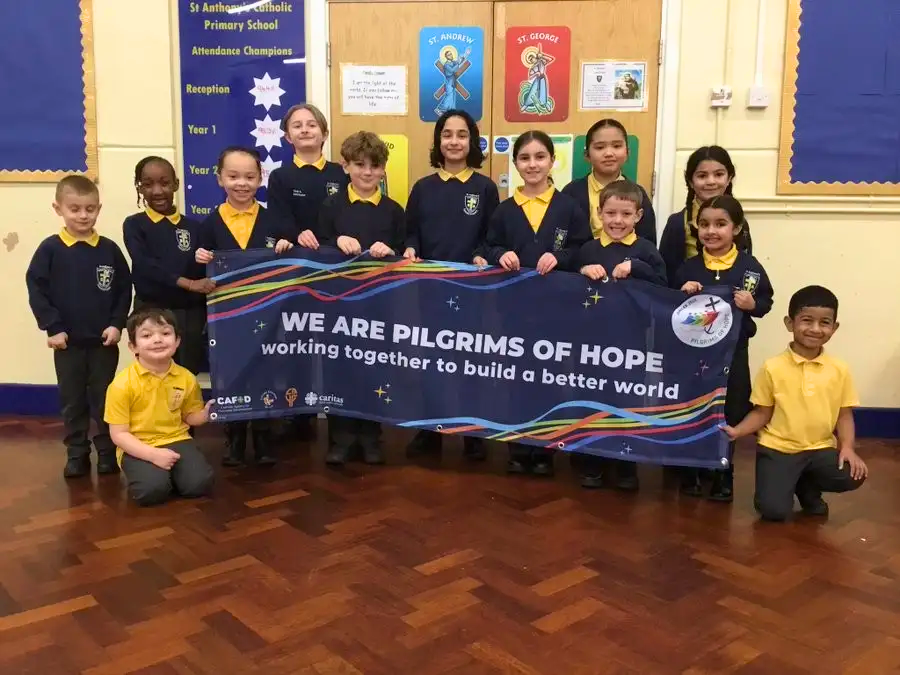
Pope Francis called on us in this Jubilee year to be Pilgrims of Hope; to build a better world for everyone and experience the joy which comes from taking action together in a world where many experience poverty, injustice and conflict. As we remember Pope Francis and give thanks for his life, we continue to be inspired by his invitation to renew our hope, a hope which comes from knowing God loves each one of us.

Since January we have seen schools in the Diocese of Leeds celebrate with many different activities: creating jubilee icons and proudly displaying banners, classroom talks and cross-town pilgrimage walks, painting windows and dressing in Jubilee colours. As part of living out their Jubilee pledge, schools have joined the wider community in asking for debt relief for the world’s poorest countries. And now it’s time to take the next steps on the journey!

St Anthony “We're delighted with how schools have responded to Pope Francis’ call to journey together with hope in this Jubilee Year,” says CAFOD’s Head of Education, Monica Conmee. “The creativity and enthusiasm have been inspiring – and we look forward to seeing more of it this summer!”

In June or July, all Catholic schools are invited to make a Jubilee Pledge to live out Catholic Social Teaching; to commit to a ‘sign of hope’ and stand in solidarity with communities experiencing poverty and advancing justice and harmony locally, nationally, and globally. Our new pope, Leo XIV, carries on Pope Francis’ work and invites us to build a Church that “seeks peace, seeks charity and wants to be as close as possible to people who suffer”.

A better world needs all of us, and the Jubilee Pledge will be a whole school, long-term commitment to take concrete actions to build a fairer world, putting Catholic Social Teaching into action, just as Pope Francis and Pope Leo have asked us to do.

The Jubilee Pledge:

We are pilgrims of hope.

We walk in solidarity with our sisters and brothers worldwide, sharing challenges and celebrating joys.

We promise to be agents of change, working together for justice, love and peace, locally and globally.

We want to build a fairer world, where every person, and the earth, can flourish.

There are a wide range of resources to support schools in preparing for and celebrating Jubilee Pledge Day, including a guide, a pledge poster, a liturgy and a short, downloadable CPD session for staff. To inspire and enthuse pupils, there is a short film that celebrates all that has been achieved so far in this Jubilee Year and looks ahead to making the Jubilee Pledge in June or July.

Jubilee Pledge Day will be a day to remember for the whole school community, with celebrations taking place in a variety of ways, with liturgies or assemblies with parents, carers and parishioners invited, or celebratory learning and fundraising activities. To share their commitment, schools will contribute to the online Pledge Map, ensuring their school name is

plotted on the map, receiving a Jubilee Pledge Certificate as a reminder of their long-term commitment to justice, peace and love. Visit jubilee-schools.org.uk for Jubilee Pledge Day inspiration and resources

Jubilee Pledge

CLIMATE CHANGE – 2000 – 2025

by David Jackson former Laudato Si Animator contact person

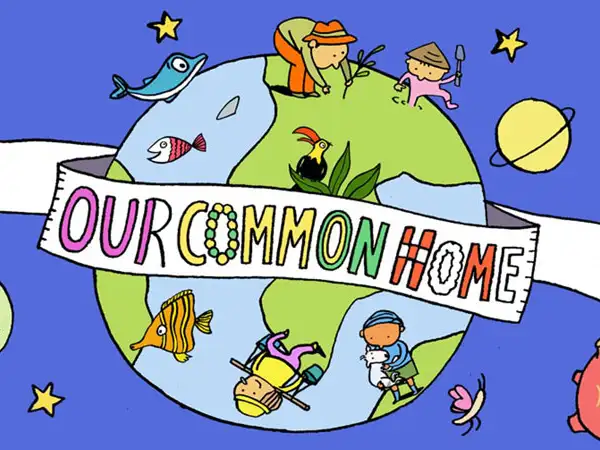
Before 2011 themes Pope Francis described in Laudato Si in 2015 as ‘Care for our Common Home’ played background music in many of our lives. Many ‘loved’ nature, the countryside, birds, flowers, gardened, grew veg. CAFOD/J&P were an accepted part of parish life.  Slowly we heard of the threats of man-made climate change. Climate change at home and its increasing impact on the poor in developing countries started to impact. It dawned that Christians needed to address and try and halt the damage we were all doing to the planet and its peoples.  

Christians began to make connections between the natural world and the presence there of the Divine – of God. They asked: what is the connection between love of Jesus in the Eucharist and in creation? Should our Church be linking these more explicitly?  

In 2015, Pope Francis issued his letter Laudato Si, ‘Care For Our Common Home’. It fell on fallow ground for increasing numbers of Catholics. 

Ten years on and Catholics realise we face a growing threat to our planet and that the cry of the earth must be linked to hearing the cry of the poor.

Does our experience of worship, community and mission in the parish mirror that awareness and provide ways forward?  Yes and no!  

DEVELOPMENTS 2000 – 2025  

  • The Diocese produced an ‘Environmental Policy’ in 2019 but no programme for implementation. 
  • CAFOD and a J&P Climate Action Group were active in promoting awareness for action on behalf of climate justice – both centrally and at parish levels – e.g. CAFOD’s ‘Living Simply’ scheme.  
  • In 2023/4 the Diocese agreed to appoint an Environmental Officer, but an appointment has been delayed due to financial constraints. The J&P Climate Action Group has members in the Curial Environmental Group.  
  • From 2020 to 2024 the Diocese had a Laudato Si Animator contact person, linking the diocese with a UK network of animators. This post remains vacant.   
AIMS 

  • To recognise that Laudato Si aspirations have not translated into effective coordination of the many disparate Diocesan efforts at parish and central levels to do so. Energies and resources to insert the messages of Laudato Si into the blood stream or DNA of the diocese must  be redoubled. 
  • Our liturgy, the love of Jesus in the Eucharist has been linked insufficiently to love of Creation.  
  • Most clergy need the support in coming to regard Laudato Si issues as a fit topic for the pulpit. The hope is that a synodally shaped Church might provide ways to do so.  
  • Parish communities must be encouraged to set up Laudato Si or ‘Green Groups’.  
  • Parishes must be encouraged to use existing resources: from the Northern Diocesan Climate Network, CAFOD, J&P Climate Action Group, and many more.   
FIND OUT MORE

The Diocese and its parishes could become the ‘Laudato Si’ ones Pope Francis urged – it has the catechetical, educational and expert resources aplenty  – it just needs the will which flows from a collective experience of climate conversion.

LAUDATO SI MOVEMENT

LIVING LAUDATO SI IN THE DIOCESE OF LEEDS

24 May – From Rerum Novarum to Pope Leo XIV via Leeds

by John Battle May 2025 at Church House

Two recent distractions; hearing echo loudly in the Eucharistic prayer at Mass after the Consecration the phrase "together in the FULLNESS of charity" and seeing our new Holy Father Pope Leo XIV hold up a copy of his namesake predecessor's foundational encyclical" Rerum Novarum". (1891).

I have been trying to discern what does that "fullness of charity" mean in practice in our context?  It goes much further than generous welfare action, charitable giving to those evidently in need or direct assistance. As "Catholic Charities" gathered here, how far are we being asked to go?

What extra do we contribute to our society?

Fullness of charity What for us today is "The Fullness of Charity" we are called to?

I start out from my own context today in Leeds working with local charities. In particular, St Monica's Housing Trust for single asylum women with "no access to public funds" until their papers and status as refugees is established. Also, in a local inner city neighbourhood New Wortley community centre in Armley in Leeds and at the now community-led successful social enterprise Bramley Baths. All three are charities registered with the national Charity Commission.

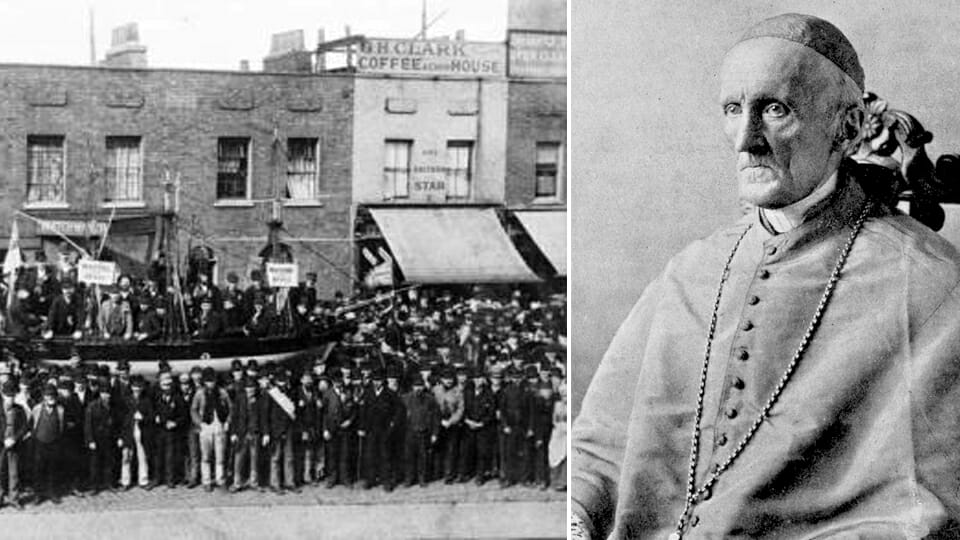
But before describing them, I want to recall a visit to Leeds on 28th Jan 1874 by Cardinal Manning. He is known as a champion of the workers and the poor in East London and the negotiator of the London dock workers’ strike. He came to Leeds and gave a lecture at the Leeds Mechanic Institute in the presence of the Mayor of Leeds on "The Dignity of work and Labour" referring to the developments of the Leeds textile industry, the treatment of workers and the impacts of poverty.

That lecture became a substantial part of the drafting and wording of "Rerum Novarum " Pope Leo XIII's foundational document for Catholic social teaching held up by the Holy Father at his first public Mass at the Vatican.

Rerum Novarum "Rerum Novarum" went through more drafts, revisions and redactions than other encyclicals (as the recovery of the draft documents in a box in 1940 revealed). It was a consultative may we say " synodal process" document.

Cardinal Ketteler of Mainz, Cardinal Manning and the French contribution Of Blessed Frederic Ozanam's St Vincent Paul Society organisation (which challenged the iron law of low pay and sent delegates of workers to Rome to petition the Vatican) were the major contributors to the encyclicals focus on workers' rights and tackling urban poverty.

Cardinal Ketteler from the heavily industrial Rhineland stressed the rights of workers to organise in trade unions and a legitimate role for the state.

Cardinal Manning focussed on the conditions of the industrial workers (not least in Leeds) and the impacts of poverty on families, pressing the case for a fair living wage and to eliminate dangerous child labour in factories. 

Created with GIMP The final text of “Rerum Novarum” was promulgated by Pope Leo XIII on 15th May 1891 - the anniversary is this month!

Cardinal Manning's contribution to "Rerum Novarum" in obvious in paragraph 3:

"By degrees it has come to pass that working men have been given over, isolated and defenceless to the callousness of employers and the greed of unrestrained competition... and to this must be added the custom of working by contract (think off the dock labourers hiring scheme each morning) and the concentration of so many branches of trade in the hands of a few individuals (think of the big five media giants) so that a small number of very rich men have been able to lay upon the masses of the poor a yoke little better than slavery itself".

How contemporary does that read and unpack in today's context!

epoch Pope Francis radically challenged us to realise that we are not in an "epoch of change" but rather in a more fundamental "change of epoch". We really are in "new times" as the title "Rerum Novarum" (changed from early drafting of "The Dignity of Labour and Workers Rights") means.

Pope Benedict XVI in his encyclical "Caritas in Veritate" set the alert in 2009

“The complexity and gravity of the present economic situation rightly causes us concern; but we must adopt a realistic attitude as we take up in confidence and hope the new responsibilities to which we are called by the prospect of a world in need of profound cultural renewal, a world that  needs to rediscover fundamental values on which to build a better future. 

The current crisis obliges us to replan our journey, to set ourselves new rules and to discover new forms of commitment, to build on positive experiences and to reject negative ones. The crisis thus becomes an opportunity in which to shape a new vision of the future." (paragraph 21)

Reviewing "Rerum Novarum" for the Dublin Review, Cardinal Manning wrote:

"For a century the civil powers in almost all the Christian world have been separating themselves from the Church, claiming and glorifying in their separation. They have set up the State as a purely secular society and have thrust the Church from them. And now they find that the millions of the world sympathise with the Church which has compassion on the multitude rather than with the state or the plutocracy which has weighed so heavily upon them."
Cardinal Manning How remarkable has been the world reception much wider than the Church itself of the life and death of Pope Francis and the election of Pope Leo XIV.

The Church's contribution throughout the centuries through its communities, parishes, monasteries, orders and charitable institutions have long supported the needs of the people often prior to and in absence of default of state and powers. Once again, the Church in practice picks up the pieces! Plus ca change!

Significantly, "Rerum Novarum" recognises the importance of the contribution of the Church and its lay institutions to supporting civil society and social well being;   

"The Church uses her efforts not only to enlighten the mind but to direct by her precepts the life and conduct of each and all. The Church improves and betters the conditions of the working men by means of numerous institutions". (paragraph 16)

Paragraph 19 continues:

"The efficacy of Christian institutions is marvellous and manifold ... there is no intermediary more powerful than religion, where the Church is the interpreter and guardian, in drawing the rich and working class together by reminding each of us of its duties to the other and especially of the obligations of justice",

Moreover

"The Church intervenes directly on behalf of the poor by setting foot and maintaining many associations which she knows to be efficient in the relief of poverty. Herein again she has always succeeded so well as to have even exhorted the praise of her enemies" (paragraph 29)

SVP The quiet and understated role of our parishioners throughout the Covid pandemic not least expressed by the SVP local conferences organising home visits (contacts through windows!) and food bank support was not unnoticed by civic authorities who remarked how significantly Catholics were the practical leaders and most active personal supporters of others.

So, facing the future we have our guide of the Catholic social teaching tradition.

Pope St John Paul II in his encyclical "Centisimus Annus" on the anniversary of Rerum Novarum stressed the need for breaking out of the state- market binary model insisting on the need to include and integrate civil society organisations.

Pope Benedict in his encyclical "Caritas in Veritate" spelt out that civil society is the most natural setting for an economy of gratuitousness and fraternity which fosters and disseminates solidarity and responsibility for the common good.

Pope Benedict introduced the concept of an "economy of communion", of caring and sharing

"Not merely matter of third sector but of a broad new composite reality embracing the private and public spheres one which does not exclude profit but instead considers it a measure for achieving human and social ends" (paragraph 86)

Bramley Baths Bramley Baths now provides a beacon exempla of that new kind of reality. A partnership of people and the public and private sectors that is not for private profit. St Monica's models a new way of lay people providing very basic supportive services in a former presbytery. 

But Pope Benedict tells us we need to go further in response to the call of the gospel:

"A sustained commitment is needed so as to promote a person based and community orientated cultural process of worldwide integration that is open to transcendence ("Caritas in Veritate" paragraph 47)

Not only must we ensure that our charities are both compassionate and professional, well governed and safeguarded but should contribute to building new relationships in imagination and hope, the new "mutual agreements" Pope Francis called for. Nor is it just an issue of regulated service provision.

Perhaps we need to be asking the deeper questions such as "What has the Charity Commission got to do with transcendence?”

We need to "re-member" and reclaim the theological concept of "the fullness of charity" which cannot be reduced to "helping the poor". We are called, as Pope Francis reminds us in his last encyclical letter, “to work for a new humanity rooted in the love of Christ" ("Dilexit Nos").

21 May – Conversations about Nonviolence

By Carol Burns, Leeds Diocese Pax Christi

At a packed Wheeler Hall on Saturday 17th May, Mahmoud Zwahre, a Palestinian activist from the West Bank, currently a scholar at Coventry University, spoke both eloquently and passionately about his experience of non-violent – or ‘unarmed’ – resistance in the West Bank. He has been active in the area south of Bethlehem – and some of the areas featured in the recent Louis Theroux documentary. After a contribution from Andrew Rigby, Emeritus Professor of Peace Studies at Coventry University, there were buzz groups and then questions to the both of them.

IMG_3858 IMG_3855 Everyone in the audience was sympathetic to the injustices that are imposed on Palestinians by the Israeli Government. Consequently, the questions focussed on what we could do to show solidarity and what brings Palestinians Hope for the future, given the current circumstances.

Mahmoud thought the Israeli Government were surprised and concerned by the level of global support for Palestine since October 2023. He urged people in this country to keep demonstrating in large numbers. His main source of Hope is that, after 77 years since the creation of Israel and despite the slow erosion of Palestinian land, the Palestinians are still occupying some of it and still have a distinctive culture.

They both made the point that violence only leads to more violence. Equally, Mahmoud said that by using violence ‘you lose some of your humanity’.

Andrew was more cautious. In his view, nothing was going to change until the USA government decided that things should change – and with Trump as President it was very difficult to predict how events might change things on the ground.

IMG_3192 Mahmoud showed a short film which can be viewed on YouTube here 

This was a partnership event between SPARK Social Justice the Leeds Palestinian Film Festival.

SVP – In-work poverty report – May 2025

Despite historically high employment rates, in-work poverty has been rising steadily in the UK for nearly two decades. This reality challenges the assumption that work alone is a reliable route out of poverty.


The St Vincent de Paul Society (SVP) has seen a significant increase in working individuals and families seeking support across England and Wales. Through our eleven regional centres and over 800 local volunteer groups, many in areas of high deprivation, the SVP provides essential frontline services. These include access to food, white goods, energy and debt advice, and help with transport costs, all tailored to local needs.

This report offers a unique and grounded perspective on in-work poverty, combining lived experience from the SVP’s grassroots network with national data and analysis. A survey of SVP members and advisers conducted over the past year reveals that in-work poverty is a complex and evolving issue. It disproportionately
affects certain demographics such as part-time workers, single-parent families, and those in precarious or low-wage sectors like hospitality and support services.

Three key findings emerged from the SVP’s research:

1. While anyone can experience in-work poverty, the highest risk groups are households with children, single parents, and those relying solely on part-time work.

2. There is no single cause. Low pay, high living costs, childcare and caring responsibilities, health issues, housing costs, and insecure employment all contribute to in-work poverty.

3. Affected individuals often face stark daily choices between food, heating, and rent. Many fall behind on bills, rely on foodbanks, and suffer from poor mental health, even while employed. While the SVP’s work on the ground can mitigate some of the impacts, we recognise the importance of tackling the structural
causes leading to in-work poverty.

The report concludes with practical, evidence-based policy recommendations aimed at creating lasting, preventative solutions to tackle in-work poverty across the UK.

Read the full report

76% of respondents told us how people
they supported and who were in work
had to face the daily choice between
essential items.