

Here are some of the Members of the Commission recommended books for Christmas. Read them yourself or give as a thoughtful gift.
‘One Day, Everyone Will Always Have Been Against This’ by Omar El Akkad
Recommended by Carol Burns
This book is about what has been happening in Gaza – see this review
https://www.theguardian.com/books/2025/feb/23/one-day-everyone-will-always-have-been-against-this-by-omar-el-akkad-review-gaza-and-the-sound-of-silence
One Day, Everyone Will Have Always Been Against This is an urgent and necessary reckoning about what it means to live in the West today. As an immigrant, Omar El Akkad believed the West offered freedom and justice for all. Over the past twenty years he reported on the various Wars on Terror, Ferguson, climate change, Black Lives Matter protests, and more. He won awards for his journalism and his fiction. But now, watching the unmitigated slaughter in Gaza, he comes to the conclusion that much of what the West promises is a lie.
This powerful book is a chronicle of Omar's painful realisation, a moral grappling with what it means - as a citizen, as a father - to carve out some sense of possibility during these devastating times. This is a book for those that have tired of moral emptiness. This is a book for everyone who wants something better.
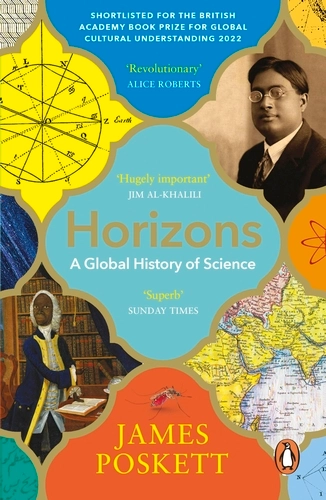
 'Horizons' by James Poskett
Recommended by Sara Forrest
James Poskett has written a global history of science in a readable way that will appeal to those interested in either history or science. He takes big themes from history, such as exploration, empire building, capitalism, Cold War and links what was happening around the world to how scientific theories developed. He demonstrates how the wisdom of the indigenous people in new worlds influenced scientific discovery. The ingenuity of Pacific navigators is astonishing.
In this major retelling of the history of science from 1450 to the present day, James Poskett explodes the myth that science began in Europe.
The blinkered Western gaze focusing on individual 'genius' - Copernicus, Newton, Darwin, Einstein - was only one part of the story. The reality was an utterly global, non-linear pattern of cross-fertilization, competition, cooperation and outright conflict. Each rupture in history carved fresh channels for global exchange.
Here, for the first time, Poskett celebrates how scientists from Africa, America, Asia and the Pacific were integral to this very human story. We meet Graman Kwasi, the African botanist who discovered a new cure for malaria; Hantaro Nagaoka, the Japanese scientist who first described the structure of the atom; and Zhao Zhongyao, the Chinese physicist who discovered antimatter.
 'Hope: The Autobiography' by Pope Francis
Recommended by Carol Burns
THE GLOBAL BESTSELLER
The ground-breaking, intimate and inspiring memoir from Pope Francis.
Books of the Year 2025: The Times, Telegraph, Guardian, Independent, Financial Times, New Statesman
'Remarkable' Guardian
'Elegant and joyful' Financial Times
Pope Francis originally intended this exceptional memoir to appear only after his death, but the needs of our times and the 2025 Jubilee Year of Hope moved him to make this precious legacy available sooner. Now, the book stands as his testament; the spiritual, faith-filled, as well as moral, social, and civic legacy that he envisioned and left for the benefit of all the men and women of the world.
HOPE is the first autobiography in history ever to be published by a Pope. Written over six years, this complete autobiography starts in the early years of the twentieth century, with Pope Francis’s Italian roots and his ancestors’ courageous migration to Latin America, continuing through his childhood, the enthusiasms and preoccupations of his youth, his vocation, adult life, and the whole of his papacy up to the present day.
In recounting his memories with intimate narrative force (not forgetting his own personal passions), Pope Francis deals unsparingly with some of the crucial moments of his papacy and writes candidly, fearlessly and prophetically about some of the most important and controversial questions of our present times: war and peace (including the conflicts in Ukraine and the Middle East), migration, environmental crisis, social policy, the position of women, sexuality, technological developments, the future of the Church and of religion in general.
HOPE includes a wealth of revelations, anecdotes and illuminating thoughts. It is a thrilling and very human memoir, moving and sometimes funny, which represents the ‘story of a life’ and, at the same time, a touching moral and spiritual testament that will fascinate readers throughout the world and will be Pope Francis’s legacy of hope for future generations.
 'Drawn to Imperfection' by David Painting
Recommended by Sara Forrest
This beautifully illustrated book takes stories from the Bible and reframes them in a way that shows us imperfect people like us experience God’s love and compassion. I read it at one sitting and can see myself re-reading it again and again.
Through imaginative storytelling and evocative artworks, Drawn to Imperfection offers an engaging and accessible invitation into the story of the Bible.
Bringing 21 biblical characters to life, each story reveals the gritty humanity of people who lived long ago, yet their struggles and triumphs are strikingly familiar to our own.
As we uncover who God was to these individuals, we are invited to see Him anew in the complexities of our everyday lives. This book is not just about understanding the Bible better; it’s about encountering the heart of God in a more intimate and honest way.
With beautifully crafted portraits and thoughtful retellings, Drawn to Imperfection will:
 ‘The finest Hotel in Kabul’ by Lyse Doucet
Recommended by Carol Burns
A must-(and enjoyable)read if you want to find out about the history of Afghanistan over the last 50 years.
When the Inter-Continental Kabul opened in 1969, Afghanistan’s first luxury hotel symbolised a dream of a modernising country connected to the world.
More than fifty years on, the Inter-Continental is still standing. It has endured Soviet occupation, multiple coups, a grievous civil war, a US invasion and the rise, fall and rise of the Taliban. History lives within its scarred windows and walls.
Lyse Doucet, the BBC’s Chief International Correspondent, has been checking into the Inter-Continental since 1988. And here, she uses its story to craft a richly immersive history of modern Afghanistan.
It is the story of Hazrat, the septuagenarian housekeeper who still holds fast to his Inter-Continental training from the hotel’s 1970s glory days – an era of haute cuisine and high fashion, when Afghanistan was a kingdom and Kabul was the ‘Paris of Asia’. It is the story of Abida, who became the first female chef to cook in the Inter-Con’s famous kitchen after the fall of the Taliban in 2001. And it is the lives of Malalai and Sadeq, the twenty-something staff who seized every opportunity offered by two decades of fragile democracy – only to witness the Taliban roaring back in 2021.
The result is a remarkably vivid history of how Afghans have survived a half century of destruction and disruption. It is the story of a hotel but also the story of a people.
 'Growing Brave' by Donna Ashworth
Recommended by Sara Forrest
Donna Ashworth has a large, loyal on-line following but as I didn’t use social media I discovered her through her poetry on Radio 4. I bought Wild Hope and regularly dip into it when I feel a little lost in the messiness of life. Bereaved friends had been given copies by their friends and found it helpful so I have given a couple of copies away too. Growing Brave is similarly reassuring when reassurance is what you need. I haven’t seen her new book Joy Chose You but I suspect that that will appear on my bookshelf soon.
In this powerful new collection of wisdom and poetry, Donna Ashworth helps us to find strength and courage on the days we feel lost, to pick ourselves up when times are hard, to soothe fear and self-doubt when we are in their grip, and to let in more life and love as we brave our challenges.
Every day we are bombarded by thoughts, feelings and information that make us feel anxious and afraid. We worry we don't measure up, we are scared of failure and we find it hard to be ourselves. We also feel powerless watching the world getting messier. Fear is a limiting factor for many of us and if we don't challenge it we can find ourselves keeping out more of the good stuff in life than the bad.
With poems such as 'One Day You'll See', 'Growing in Moonlight', 'The Comparing' and 'Always There', bestselling author Donna Ashworth helps us to see that whatever we are facing, no matter how small or afraid we feel, we make the biggest difference in this world and to our own happiness when we are brave enough to show up as ourselves.
 'Domination' by Alice Roberts
Recommended by Sara Forrest
I haven’t yet read Alice Roberts new book about the spread of Christianity as I anticipate that it will be a Christmas present. I enjoyed The Celts which she wrote to accompany a TV Series. In that she explains how the archaeological record suggests the spread of Celtic culture up the Atlantic Coast and separately across mainland Europe predominantly through trade and migration to support trade rather than invasion. Her style is easy to understand and accessible. This is the story of the fall of an Empire – and the rise of another.
Who spread Christianity, how, and why? In her quest to find the answer, Professor Alice Roberts takes us on a gripping investigative journey. From a secluded valley in south Wales to the shores of Brittany; from the heart of the Roman Empire in a time of political turmoil to the ancient city of Corinth in the footsteps of the apostle Paul; from Alexandria in the fourth century to Constantinople.
As the Roman Empire crumbled in Western Europe, a shadow of power remained, almost perfectly mapping onto its disappearing territories. And then, it continued to spread. Unearthing the archaeological clues and challenging long-established histories, Professor Roberts tells a remarkable story about the relationship between the Roman Empire and Christianity.
Lifting the veil on secrets that have been hidden in plain sight, this story is nothing short of astonishing.
Domination is a page-turning exploration of power and its survival.
 'Ted the Shed' by Mandy Sutter
Recommended by Sara Forrest
My husband chose this on a recent visit to our local Bookshop (Trumans Books, Farsley). It’s written by Mandy Sutter (another writer on social media writer) and is a fond biography of the last year’s of her dad’s life when she needed his help with her new allotment.
When Mandy’s Dad finally makes it to the top of the allotment waiting list aged 87, he is offered an unpromising jungle of a plot. He tells his daughter that she has always dreamed of having an allotment and a gardening relationship begins, full of resentment, disappointment and potatoes that grow large enough to appear on Google Earth.
John picked it up and started reading while he drank his coffee and he decided it was worth buying (a change from science fiction or crime). It’s a celebration of the life of someone who was well-loved. Her wry observations reduce the sentimentality. I enjoyed it too and suspect that many people who enjoy growing things would enjoy an afternoon’s escape into its pages.

‘One Day, Everyone Will Always Have Been Against This’ by Omar El Akkad
Recommended by Carol Burns
This book is about what has been happening in Gaza – see this review
https://www.theguardian.com/books/2025/feb/23/one-day-everyone-will-always-have-been-against-this-by-omar-el-akkad-review-gaza-and-the-sound-of-silence
One Day, Everyone Will Have Always Been Against This is an urgent and necessary reckoning about what it means to live in the West today. As an immigrant, Omar El Akkad believed the West offered freedom and justice for all. Over the past twenty years he reported on the various Wars on Terror, Ferguson, climate change, Black Lives Matter protests, and more. He won awards for his journalism and his fiction. But now, watching the unmitigated slaughter in Gaza, he comes to the conclusion that much of what the West promises is a lie.
This powerful book is a chronicle of Omar's painful realisation, a moral grappling with what it means - as a citizen, as a father - to carve out some sense of possibility during these devastating times. This is a book for those that have tired of moral emptiness. This is a book for everyone who wants something better.
'Horizons' by James PoskettRecommended by Sara Forrest
James Poskett has written a global history of science in a readable way that will appeal to those interested in either history or science. He takes big themes from history, such as exploration, empire building, capitalism, Cold War and links what was happening around the world to how scientific theories developed. He demonstrates how the wisdom of the indigenous people in new worlds influenced scientific discovery. The ingenuity of Pacific navigators is astonishing.
In this major retelling of the history of science from 1450 to the present day, James Poskett explodes the myth that science began in Europe.
The blinkered Western gaze focusing on individual 'genius' - Copernicus, Newton, Darwin, Einstein - was only one part of the story. The reality was an utterly global, non-linear pattern of cross-fertilization, competition, cooperation and outright conflict. Each rupture in history carved fresh channels for global exchange.
Here, for the first time, Poskett celebrates how scientists from Africa, America, Asia and the Pacific were integral to this very human story. We meet Graman Kwasi, the African botanist who discovered a new cure for malaria; Hantaro Nagaoka, the Japanese scientist who first described the structure of the atom; and Zhao Zhongyao, the Chinese physicist who discovered antimatter.
'Hope: The Autobiography' by Pope FrancisRecommended by Carol Burns
THE GLOBAL BESTSELLER
The ground-breaking, intimate and inspiring memoir from Pope Francis.
Books of the Year 2025: The Times, Telegraph, Guardian, Independent, Financial Times, New Statesman
'Remarkable' Guardian
'Elegant and joyful' Financial Times
Pope Francis originally intended this exceptional memoir to appear only after his death, but the needs of our times and the 2025 Jubilee Year of Hope moved him to make this precious legacy available sooner. Now, the book stands as his testament; the spiritual, faith-filled, as well as moral, social, and civic legacy that he envisioned and left for the benefit of all the men and women of the world.
HOPE is the first autobiography in history ever to be published by a Pope. Written over six years, this complete autobiography starts in the early years of the twentieth century, with Pope Francis’s Italian roots and his ancestors’ courageous migration to Latin America, continuing through his childhood, the enthusiasms and preoccupations of his youth, his vocation, adult life, and the whole of his papacy up to the present day.
In recounting his memories with intimate narrative force (not forgetting his own personal passions), Pope Francis deals unsparingly with some of the crucial moments of his papacy and writes candidly, fearlessly and prophetically about some of the most important and controversial questions of our present times: war and peace (including the conflicts in Ukraine and the Middle East), migration, environmental crisis, social policy, the position of women, sexuality, technological developments, the future of the Church and of religion in general.
HOPE includes a wealth of revelations, anecdotes and illuminating thoughts. It is a thrilling and very human memoir, moving and sometimes funny, which represents the ‘story of a life’ and, at the same time, a touching moral and spiritual testament that will fascinate readers throughout the world and will be Pope Francis’s legacy of hope for future generations.
'Drawn to Imperfection' by David PaintingRecommended by Sara Forrest
This beautifully illustrated book takes stories from the Bible and reframes them in a way that shows us imperfect people like us experience God’s love and compassion. I read it at one sitting and can see myself re-reading it again and again.
Through imaginative storytelling and evocative artworks, Drawn to Imperfection offers an engaging and accessible invitation into the story of the Bible.
Bringing 21 biblical characters to life, each story reveals the gritty humanity of people who lived long ago, yet their struggles and triumphs are strikingly familiar to our own.
As we uncover who God was to these individuals, we are invited to see Him anew in the complexities of our everyday lives. This book is not just about understanding the Bible better; it’s about encountering the heart of God in a more intimate and honest way.
With beautifully crafted portraits and thoughtful retellings, Drawn to Imperfection will:
- Offer a fresh perspective on the Bible’s big story.
- Inspire a deeper, more authentic relationship with God.
- Encourage you to live with greater freedom and deeper connection.
‘The finest Hotel in Kabul’ by Lyse DoucetRecommended by Carol Burns
A must-(and enjoyable)read if you want to find out about the history of Afghanistan over the last 50 years.
When the Inter-Continental Kabul opened in 1969, Afghanistan’s first luxury hotel symbolised a dream of a modernising country connected to the world.
More than fifty years on, the Inter-Continental is still standing. It has endured Soviet occupation, multiple coups, a grievous civil war, a US invasion and the rise, fall and rise of the Taliban. History lives within its scarred windows and walls.
Lyse Doucet, the BBC’s Chief International Correspondent, has been checking into the Inter-Continental since 1988. And here, she uses its story to craft a richly immersive history of modern Afghanistan.
It is the story of Hazrat, the septuagenarian housekeeper who still holds fast to his Inter-Continental training from the hotel’s 1970s glory days – an era of haute cuisine and high fashion, when Afghanistan was a kingdom and Kabul was the ‘Paris of Asia’. It is the story of Abida, who became the first female chef to cook in the Inter-Con’s famous kitchen after the fall of the Taliban in 2001. And it is the lives of Malalai and Sadeq, the twenty-something staff who seized every opportunity offered by two decades of fragile democracy – only to witness the Taliban roaring back in 2021.
The result is a remarkably vivid history of how Afghans have survived a half century of destruction and disruption. It is the story of a hotel but also the story of a people.
'Growing Brave' by Donna AshworthRecommended by Sara Forrest
Donna Ashworth has a large, loyal on-line following but as I didn’t use social media I discovered her through her poetry on Radio 4. I bought Wild Hope and regularly dip into it when I feel a little lost in the messiness of life. Bereaved friends had been given copies by their friends and found it helpful so I have given a couple of copies away too. Growing Brave is similarly reassuring when reassurance is what you need. I haven’t seen her new book Joy Chose You but I suspect that that will appear on my bookshelf soon.
In this powerful new collection of wisdom and poetry, Donna Ashworth helps us to find strength and courage on the days we feel lost, to pick ourselves up when times are hard, to soothe fear and self-doubt when we are in their grip, and to let in more life and love as we brave our challenges.
Every day we are bombarded by thoughts, feelings and information that make us feel anxious and afraid. We worry we don't measure up, we are scared of failure and we find it hard to be ourselves. We also feel powerless watching the world getting messier. Fear is a limiting factor for many of us and if we don't challenge it we can find ourselves keeping out more of the good stuff in life than the bad.
With poems such as 'One Day You'll See', 'Growing in Moonlight', 'The Comparing' and 'Always There', bestselling author Donna Ashworth helps us to see that whatever we are facing, no matter how small or afraid we feel, we make the biggest difference in this world and to our own happiness when we are brave enough to show up as ourselves.
'Domination' by Alice RobertsRecommended by Sara Forrest
I haven’t yet read Alice Roberts new book about the spread of Christianity as I anticipate that it will be a Christmas present. I enjoyed The Celts which she wrote to accompany a TV Series. In that she explains how the archaeological record suggests the spread of Celtic culture up the Atlantic Coast and separately across mainland Europe predominantly through trade and migration to support trade rather than invasion. Her style is easy to understand and accessible. This is the story of the fall of an Empire – and the rise of another.
Who spread Christianity, how, and why? In her quest to find the answer, Professor Alice Roberts takes us on a gripping investigative journey. From a secluded valley in south Wales to the shores of Brittany; from the heart of the Roman Empire in a time of political turmoil to the ancient city of Corinth in the footsteps of the apostle Paul; from Alexandria in the fourth century to Constantinople.
As the Roman Empire crumbled in Western Europe, a shadow of power remained, almost perfectly mapping onto its disappearing territories. And then, it continued to spread. Unearthing the archaeological clues and challenging long-established histories, Professor Roberts tells a remarkable story about the relationship between the Roman Empire and Christianity.
Lifting the veil on secrets that have been hidden in plain sight, this story is nothing short of astonishing.
Domination is a page-turning exploration of power and its survival.
'Ted the Shed' by Mandy SutterRecommended by Sara Forrest
My husband chose this on a recent visit to our local Bookshop (Trumans Books, Farsley). It’s written by Mandy Sutter (another writer on social media writer) and is a fond biography of the last year’s of her dad’s life when she needed his help with her new allotment.
When Mandy’s Dad finally makes it to the top of the allotment waiting list aged 87, he is offered an unpromising jungle of a plot. He tells his daughter that she has always dreamed of having an allotment and a gardening relationship begins, full of resentment, disappointment and potatoes that grow large enough to appear on Google Earth.
John picked it up and started reading while he drank his coffee and he decided it was worth buying (a change from science fiction or crime). It’s a celebration of the life of someone who was well-loved. Her wry observations reduce the sentimentality. I enjoyed it too and suspect that many people who enjoy growing things would enjoy an afternoon’s escape into its pages.

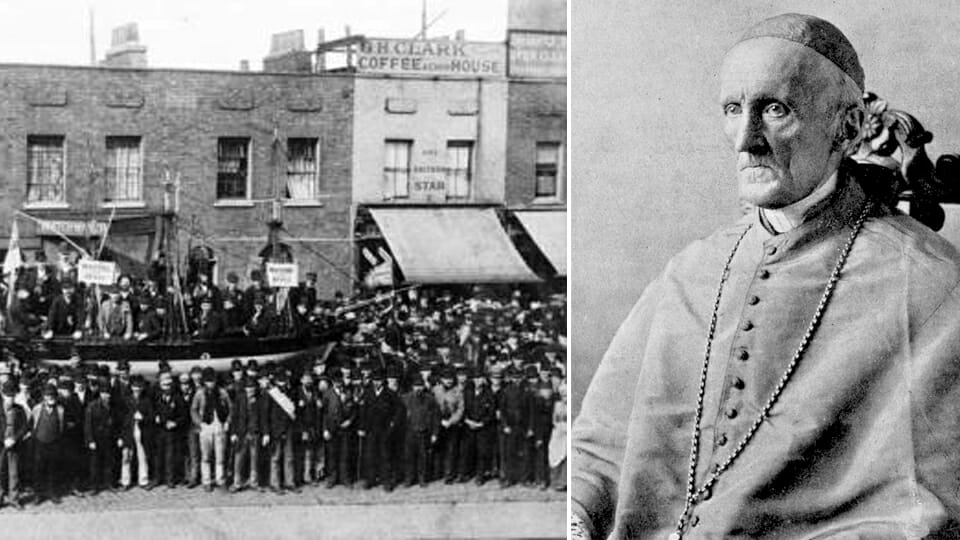
 "Rerum Novarum" went through more drafts, revisions and redactions than other encyclicals (as the recovery of the draft documents in a box in 1940 revealed). It was a consultative may we say " synodal process" document.
 The final text of “Rerum Novarum” was promulgated by Pope Leo XIII on 15th May 1891 - the anniversary is this month!
 Pope Francis radically challenged us to realise that we are not in an "epoch of change" but rather in a more fundamental "change of epoch". We really are in "new times" as the title "Rerum Novarum" (changed from early drafting of "The Dignity of Labour and Workers Rights") means.
 How remarkable has been the world reception much wider than the Church itself of the life and death of Pope Francis and the election of Pope Leo XIV.
 The quiet and understated role of our parishioners throughout the Covid pandemic not least expressed by the SVP local conferences organising home visits (contacts through windows!) and food bank support was not unnoticed by civic authorities who remarked how significantly Catholics were the practical leaders and most active personal supporters of others.
 Bramley Baths now provides a beacon exempla of that new kind of reality. A partnership of people and the public and private sectors that is not for private profit. St Monica's models a new way of lay people providing very basic supportive services in a former presbytery.

 For our Leeds Diocese Justice and Peace Commission especially, Pope Francis has left us two key workbooks; his encyclical letters "Laudato Si" and "Fratelli Tutti".
 His watchword for the Church in our times was to be a "church for the poor" and to lead by being a "field hospital" - mobile and active among the people, binding the wounds in practical service especially to the poor, the homeless, refugees and victims of violence and war.
 He concludes:
 Pope Francis for now deserves these last words.
