

by Sara Forrest, Our Lady of Kirkstall Parish
Our Lady of Kirkstall Parish Retreat
Our Retreat was organised by the Parish Live Simply group and the programme was developed from the CAFOD Jubilee booklet. There were two themes within the event:
Jesus the Bringer of Good News
Jesus – Lord of Creation
We started with a Jubilee Mass said by Fr Michael. This was followed by coffees/teas and biscuits. Sir John Battle then gave a keynote address. An impactful story from his Men’s Walking group involved a young man with learning disabilities living on his own in a block of flats. After he didn’t arrive one week John went to check he was OK. When he found him the young man told him he was living in a tent. He had been sanctioned (benefits stopped) by DWP for not attending an interview.
He told John that he’d been too scared about being conscripted by DWP into the Ukrainian Army to fight Russians to attend. John then took him to the Job Centre and explained the reason why and got the benefits reinstated. John’s love and care had been Good News.
 The shared lunch consisted of a varied array of savoury foods and leftovers were taken home to avoid food waste.
Approximately 20 attendees then attended two 45 minute workshops based on the two themes. Workshops comprised prayers, spiritual readings and discussions followed by making a personal pledges to do something extra.
For Bringing Good News, Cherie, an Anglican Church Warden on the Hawksworth Estate (in one of the most deprived areas in UK) told how after being told by God to feed his people she started, with the blessing of the Vicar, a food bank and kitchen on the estate. She and her fellow volunteers have expanded their services to include baby items, period products, household products and Warmth packs. A truly inspiring lady and talk.
 One of the S V P conferences then listed the different types of help they had given over the previous 12 months. The range of help given surprised parishioners e.g. paying the food pantry weekly subscription of £6 for a young mother of three children when she couldn’t afford it at the end of some months. Information about the S V P Support Centre on York Road, the Food Pantry run from the Tinshill Shop and about the Butcher Hill Shop were also given.
The beautiful posters created in earlier workshops provided a colourful backdrop of God Lord of Creation in the other workshop. The prayers and lively discussions focussed on thankfulness and the many ways individuals can chose to consume less and reduce their climate impact. For example one participant was keen to keep bees in their garden but could not do so because their landlord wouldn’t allow it.
The pledges were brought forward during the closing prayers before being taken away by individuals.
Happily a couple of people were contemplating joining the S V P as a result of the retreat. As both conferences need new members this was great!
Useful Links
SVP Leeds - St Vincent's Centre
St Mary’s St Andrew’s Food Project
Vinnie's Pantry, Tinshill
Butchers Hill Shop
Our Lady of Kirkstall Parish
CAFOD Jubilee Parish Resources
Our Lady of Kirkstall Parish Retreat
Our Retreat was organised by the Parish Live Simply group and the programme was developed from the CAFOD Jubilee booklet. There were two themes within the event:
Jesus the Bringer of Good News
Jesus – Lord of Creation
We started with a Jubilee Mass said by Fr Michael. This was followed by coffees/teas and biscuits. Sir John Battle then gave a keynote address. An impactful story from his Men’s Walking group involved a young man with learning disabilities living on his own in a block of flats. After he didn’t arrive one week John went to check he was OK. When he found him the young man told him he was living in a tent. He had been sanctioned (benefits stopped) by DWP for not attending an interview.
He told John that he’d been too scared about being conscripted by DWP into the Ukrainian Army to fight Russians to attend. John then took him to the Job Centre and explained the reason why and got the benefits reinstated. John’s love and care had been Good News.
The shared lunch consisted of a varied array of savoury foods and leftovers were taken home to avoid food waste.Approximately 20 attendees then attended two 45 minute workshops based on the two themes. Workshops comprised prayers, spiritual readings and discussions followed by making a personal pledges to do something extra.
For Bringing Good News, Cherie, an Anglican Church Warden on the Hawksworth Estate (in one of the most deprived areas in UK) told how after being told by God to feed his people she started, with the blessing of the Vicar, a food bank and kitchen on the estate. She and her fellow volunteers have expanded their services to include baby items, period products, household products and Warmth packs. A truly inspiring lady and talk.
One of the S V P conferences then listed the different types of help they had given over the previous 12 months. The range of help given surprised parishioners e.g. paying the food pantry weekly subscription of £6 for a young mother of three children when she couldn’t afford it at the end of some months. Information about the S V P Support Centre on York Road, the Food Pantry run from the Tinshill Shop and about the Butcher Hill Shop were also given.The beautiful posters created in earlier workshops provided a colourful backdrop of God Lord of Creation in the other workshop. The prayers and lively discussions focussed on thankfulness and the many ways individuals can chose to consume less and reduce their climate impact. For example one participant was keen to keep bees in their garden but could not do so because their landlord wouldn’t allow it.
The pledges were brought forward during the closing prayers before being taken away by individuals.
Happily a couple of people were contemplating joining the S V P as a result of the retreat. As both conferences need new members this was great!
Useful Links
SVP Leeds - St Vincent's Centre
St Mary’s St Andrew’s Food Project
Vinnie's Pantry, Tinshill
Butchers Hill Shop
Our Lady of Kirkstall Parish
CAFOD Jubilee Parish Resources


 In Practice our parishes are places of welcome. The contribution of Catholics to supporting migrants and refugees in our Diocese is quietly understated. Asylum seekers put in hotels are visited and helped to resettle as refugees in our neighbourhoods with visits and practical material support not least by members of the SVP parish conferences.
  Recently a well-attended open "briefing session" on asylum and refugees was organised to challenge the myths and misinformation starting again to dominate a media approach addicted to alarming rather than informing. Notably, around the city graffiti is appearing "Illegals are criminals" echoing the Trump tropes.
  Clarifying the difference between migrants (immigrants and emigrants who come and go worldwide and mostly in the global South) and those forced out of their homes to seek refuge is crucial. Notably most fleeing conflicts violence or persecution become "internally displaced persons" within their own country. (Over half of the 118 million forcibly moved in 2024).
  The UNCHR opposes this damaging description recommending the term "Irregular " migration pointing out (as does Catholic social teaching) that defining people as "illegal " denies their basic humanity. What's more people can become irregular in numerous ways (and through no fault of their own) that are not "criminal", such as overstaying work permits or educational visas, not possessing proper or updated documentation, historical lack of paperwork (cf Windrush generation).
  In other words, the UK takes far less refugees than other European countries and far less than neighbouring poor countries in Africa. Our contribution of welcoming the desperate stranger is presently far exaggerated.
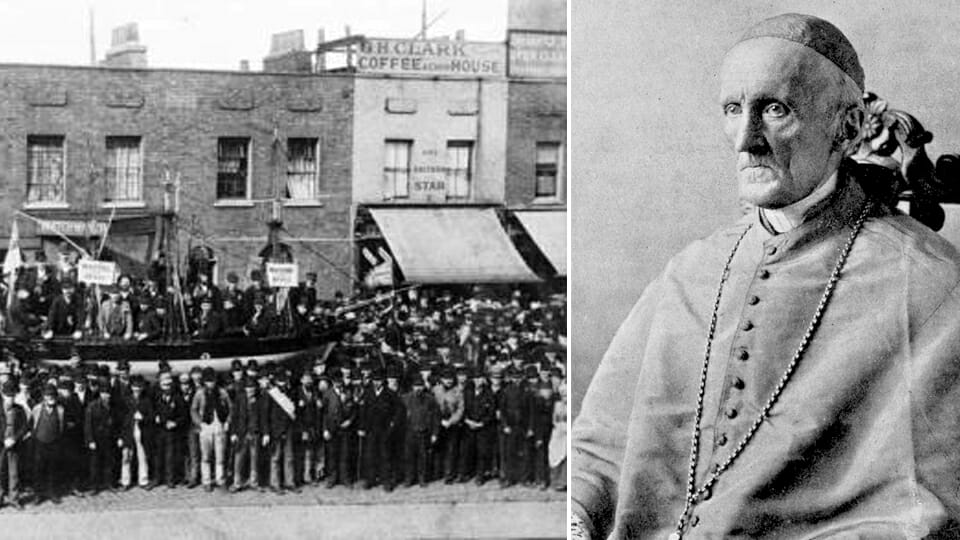
 "Rerum Novarum" went through more drafts, revisions and redactions than other encyclicals (as the recovery of the draft documents in a box in 1940 revealed). It was a consultative may we say " synodal process" document.
 The final text of “Rerum Novarum” was promulgated by Pope Leo XIII on 15th May 1891 - the anniversary is this month!
 Pope Francis radically challenged us to realise that we are not in an "epoch of change" but rather in a more fundamental "change of epoch". We really are in "new times" as the title "Rerum Novarum" (changed from early drafting of "The Dignity of Labour and Workers Rights") means.
 How remarkable has been the world reception much wider than the Church itself of the life and death of Pope Francis and the election of Pope Leo XIV.
 The quiet and understated role of our parishioners throughout the Covid pandemic not least expressed by the SVP local conferences organising home visits (contacts through windows!) and food bank support was not unnoticed by civic authorities who remarked how significantly Catholics were the practical leaders and most active personal supporters of others.
 Bramley Baths now provides a beacon exempla of that new kind of reality. A partnership of people and the public and private sectors that is not for private profit. St Monica's models a new way of lay people providing very basic supportive services in a former presbytery.


