The Israeli army (IDF) has declared the Christian town of Taybeh - the last entirely Christian community in the occupied West Bank - a 'closed military zone' - prohibiting Israelis, foreign nationals, and journalists from entering. The army says this is to protect Taybeh from the illegal settlers that have been attacking the town for months.
Taybeh Mayor Suleiman Khoury said that restricting foreign visitors will have a serious economic impact because Taybeh is a popular religious and tourist destination with hotels, restaurants and other businesses relying heavily on visitors.
But the ban also means international activists, human rights observers, and journalists will no longer be able to enter the village to document or respond to the daily attacks by Israeli settlers. Many observers have noted that the IDF has tended to stand by and watch while 'settlers' have rampaged through Christian land and homes in Taybeh.
Ihab Hassan, a Palestinian Christian human rights advocate wrote: "This is a deeply alarming new measure and another step by the Israeli government and army toward the ethnic cleansing of the last entirely Christian village in the West Bank. They want to do it in silence - without witnesses, without journalists, and without the world noticing.
"Instead of arresting the settler terrorists responsible for these attacks, the authorities are banning the journalists and activists who document them from entering the village.
"If this continues, the survival of the last entirely Christian Palestinian village in the West Bank is at serious risk."
Father Bashar Fawadleh, parish priest of Christ the Redeemer Church in Taybeh, said in a statement: "From the perspective of the church, we welcome any serious measure whose real purpose is to protect our people, their homes, their lands and their freedom to live in security and dignity.
"The declaration of Taybeh as a closed military zone for non-resident Israelis may be a positive step if it is genuinely and consistently enforced to prevent settlers from entering our lands and carrying out further attacks. What matters to us, however, is not the announcement itself, but what happens on the ground in the coming days and weeks.
"For months, our community has experienced repeated incursions into private and agricultural lands, intimidation of families and workers, fires, armed presence, the entry of settlers and their livestock onto private property and attempts to establish a permanent presence around the village. These incidents have created fear and are threatening the normal life and future of our Christian community.
"As a Church, we therefore say clearly: protection must mean protection. The responsibility cannot be placed on the victims by restricting their lives, access to their lands or freedom of movement. The restrictions must be directed against those who enter illegally, threaten residents, damage property or attempt to take control of land.
"We will judge this decision by its results: Are the attacks stopped? Can our farmers safely reach their land? Can families live in their homes without fear? Are attempts to establish new settler outposts around Taybeh prevented?
"Taybeh does not ask for privileges. We ask for the basic right to remain peacefully on our land and to preserve a Christian presence that has existed here for centuries.
"If this decision provides real and lasting protection, we will welcome it. But it must be implemented seriously and accompanied by accountability for those responsible for the attacks. Temporary measures are not enough. What Taybeh needs is lasting security, justice and the protection of its people and land.
"At this stage, we still do not have clear information about the details of how this decision will be implemented, how it will translate into practice on the ground, which areas will actually be covered by the measures, or how they will be enforced and monitored.
"For this reason, we cannot judge the decision solely by its announcement. We will assess it by the way it is implemented and by its actual impact on the lives, security, and freedom of movement of the people."
In an interview with Vatican News, Fr Fawadleh appealed for prayers from the global church.
He said: "Do not forget Taybeh. I invite every Catholic diocese worldwide to speak out about the situation here, to talk about these Christian brothers and sisters who are living in terror. The birthplace of the Christian community must not vanish into silence. Together, we can preserve this living testament of faith."
"Through your platform, I would like to appeal directly to Pope Leo XIV to intervene for this last Christian village in the West Bank, so that these settler attacks cease and the occupation of our land stops. We simply want to live in peace, with justice and dignity.
"It is a vital, foundational symbol for everyone, especially as we prepare for the 2033 Jubilee, marking two millennia since Jesus Christ walked this earth. Taybeh stands on the front lines of preserving Christianity here in the Holy Land. Jesus chose to seek refuge in Taybeh before his passion, death, and resurrection. We must remain a living testament to Christianity and its enduring presence in the Holy Land. The world must stand with Taybeh."
LINKS
Two charities supporting the Christian community in Taybeh are:
It was supposed to be an ordinary journey: leaving Ramallah in the morning, crossing the bridge into Jordan, attend the ceremony of religious vows for three dear sisters, and later returning with my mother. Geographically, it is not a long distance, and under normal circumstances, such a journey should not require so much planning, time, money, and stress. But in Palestine, distances are not measured in kilometres alone.
The complications began even before reaching the bridge. Leaving the Ramallah area took longer because one of the checkpoints along the way was closed. This is nothing exceptional in our daily lives. You may leave home knowing where you are going, but you do not know which road will still be open when you reach it, or how long it will actually take you to get there.
The situation becomes even more complicated when other roads are closed, as is happening in the Taybeh area. The closure of a single road does not affect only the residents of one village. It alters traffic throughout an entire area, increases pressure on alternative routes, and turns short distances into longer and more exhausting journeys. And so, before the actual journey has even begun, you have already gone through another journey simply to reach the crossing point.
When I finally reached the bridge, the number of travellers was overwhelming. I found myself with two choices: wait amid the crowds, with all the exhaustion and uncertainty that this entails, or use the VIP service to make the crossing easier. I chose the second option, not because I was looking for luxury, but because the crowds were more than I could manage and because I needed to travel and return with my mother.
At first, I thought the service would cost around $100. Then I discovered that I was mistaken: the actual cost was closer to $130. On top of that, there are approximately $70 in fees paid to the Israeli side upon departure. We are therefore already at around $200, and that is before even reaching Jordan, where additional fees still have to be paid.
And the expenses do not end with official fees. There are taxis, high transportation costs, and what travellers sometimes experience as exploitation by certain drivers who take advantage of their need and the lack of alternatives. When you urgently need to reach the bridge, leave it, or move from one point to another, you are not always in a position to compare prices or calmly search for a better option. You simply need to continue your journey, and that necessity itself can become an opportunity for prices to be inflated.
In the end, I found myself paying around 560 shekels instead of the roughly 250 shekels I had expected for part of this journey. The irony is that the total amount one can end up paying simply to travel from Palestine to Jordan can sometimes equal the price of a plane ticket to certain European destinations. We are talking about crossing a few dozen kilometres, not travelling between countries and continents.
Of course, I could have chosen not to use the VIP service. But that is precisely the point: sometimes all the options available to you are bad ones. Either you pay an excessive amount, or you face hours of crowds, waiting, and exhaustion, without knowing exactly when your journey will end.
The problem is not one incident, one checkpoint, or even one side. It is the daily accumulation of obstacles. An Israeli checkpoint may be closed, a road may be blocked, the bridge may be overcrowded, procedures and fees await you on both sides of the border, transportation costs are high, and some taxi drivers take advantage of the situation. At every stage, another obstacle appears, Israeli or Arab, official or unofficial.
This is sometimes difficult to explain to someone who lives in a place where they can simply get into their car and drive one or two hundred kilometres without having to think about anything beyond ordinary traffic. Here, even visiting a neighbouring country, or simply going to bring your mother home, can become an entire operation requiring calculations of time, money, checkpoints, crowds, open and closed roads, fees, and taxi fares.
And in moments of anger, you feel that everything has become difficult: because of Israelis and because of Arabs, because of occupation and because of disorder, because of checkpoints and because of the bridge, because of fees and because of exploitation. Everyone adds something to the burden, and in the end there is one ordinary human being who pays the price, financially and psychologically.
We are not asking for a privilege. We simply want something that seems perfectly ordinary in most parts of the world: to be able to go to work, visit our families, travel to a neighbouring country, and return home without every journey becoming yet another test of patience and endurance.
Today, I paid more than I wanted to pay, waited longer than I expected, and travelled a route far more complicated than it should have been. There is nothing I can change about that now. I will continue my journey, bring my mother home, and try to rest.
But the painful paradox remains: in this very small part of the world, a distance may be very short on a map, yet become extraordinarily long, complicated, and expensive in a person’s life.
Friends of the Holy Land are looking for local volunteers to deliver talks in Catholic parishes, schools and colleges to help raise awareness of their work and inspire fundraising activity.
The role of the Volunteer Ambassador is to present and promote the work of Friends of the Holy Land (FHL) in the area/region of both Catholic and Anglican dioceses close to place of residence. You will be asked to give up to 8 appeals each year in local area parishes and may be asked to also give occasional talks to locals schools, universities, or groups. You will receive a flat fee for expenses for this role and will need to complete an interview.
Edmund Adamus, Advocacy and Engagement Manager at Friends of the Holy Land also hosts a monthly information webinar every fourth Monday of the month at 19.30 for 45 minutes. This is for anyone wishing to find out more about their work and the urgency of the mission to assist and sustain our vulnerable fellow Christians in Gaza, West Bank, Israel and Jordan at this time.
Just use this link to register to attend on your preferred date and receive the online invitation.
📍Quaker Meeting house on Woodhouse Lane, next to Notre Dame.
The Yorkshire Gaza Families Fund (YGFF) is a grassroots, community-led mutual aid initiative in the Yorkshire region that raises money to send directly to four large families (totaling 400 to 600 individuals) trapped in Gaza who have relatives living in and around Leeds.
They are organising two days of events in June at the Quaker Meeting house on Woodhouse Lane, next to Notre Dame, including a showing of Aisha's Story - shown by the Leed's Palestinian Film Festival for International Women's Day, March 2026
Cardigan Community Centre, 145-149 Cardigan Rd, Burley, Leeds LS6 1LJ
Join Global Justice Youth’s annual activist conference, We Rise, to learn from inspiring international speakers, join collaborative workshops and meet likeminded people.
This year’s line-up already includes
Rahila Gupta, chair of Southall Black Sisters and co-author of Planet Patriarchy: Global Tales of Feminism and Oppression
Pallavi Pundir, journalist and researcher on gender and democratic movements in Asia
Nick Dearden, director of Global Justice Now and author of Pharmanomics: How Big Pharma Destroys Global Health
Keir Milburn, co-director of Abundance thinktank, author of Generation Left and Radical Abundance: How to Win a Green Democratic Future
Professor Paul Routledge, author of Space Invaders: Radical Geographies of Protest, scholar of global social movements
Alyssa Elliott, founder of Indivisible London, campaigner against Donald Trump
Young people are leading resistance to the far right, the genocide in Gaza and fossil fuels all across the world. While extreme nationalism rises in the US, UK and globally, it is being challenged on the streets and in new political movements by leaders like Zohran Mamdani and Zack Polanski who bring together climate justice, internationalism and the urgent need to fight inequality and make our lives affordable. In the global south, Gen Z-led revolts have toppled autocrats from Nepal to Madagascar.
At We Rise we’ll hear strategies with incredible international speakers on the front lines of each of these struggles. We’ll be bringing together organisers from across the world to share lessons from the last year of youth led resistance. We’ll be planning what to do next and how we can make 2026 a year of solidarity and global justice.
We Rise is for anyone under 30 who believes that another world is possible. With a range of panels, interactive workshops and creative sessions there’s something for everyone.
This is the title of a new half hour documentary that had its premiere on 4th December as part of the Leeds Palestinian Film festival. The premiere was held at All Hallows church in the Burley area of Leeds and was attended by about 80 people. The film has been made by Juman Quneis, a Palestinian filmmaker from Ramallah in the West Bank, who, until recently, was studying in Leeds.
She recounts that the idea for the film came about when she was just walking through central Leeds on a Tuesday lunchtime and was intrigued to see a Palestinian flag. When she moved closer, she saw that it was a group of women, all dressed in black, with banners saying ceasefire now’ and ‘stop the genocide’. This was the Leeds Women in Black group who hold an hour-long silent vigil every week in Dortmund Square. After talking with some of them, the idea of making a film about the individuals who take part in the vigil took root. She was surprised by the level of knowledge about the Palestinian struggle and that women living so far away and with little, if any, direct connection to the Middle East should commit themselves to doing this on a regular basis. The result is a well-crafted and insightful look at the background to the motivations and thinking of the women who set up this group.
At the start there were often less than a dozen women taking part. Nowadays the numbers have grown to between 30 to 40. Members of the Leeds Diocese Pax Christi often are part of the vigil and one, Carol Burns, is interviewed in the film.
Juman and Carol
Juman is enthusiastic about showing this film to, in particular, Palestinian women's groups. She wants people in Gaza and the West Bank to know that there are others across the world who stand in solidarity with them as they suffer the ongoing injustices inflicted on them by successive Israeli Governments.
This film will shortly be available for use as a discussion starter point for any groups who want to explore both what is happening in Israel Palestine and to explore how change happens (what is the point of a silent vigil?).
This is the title of a new half hour documentary that had its premiere on 4th December as part of the Leeds Palestinian Film festival. The premiere was held at All Hallows church in the Burley area of Leeds and was attended by about 80 people. The film has been made by Juman Quneis, a Palestinian filmmaker from Ramallah in the West Bank, who is currently studying in Leeds.
She recounts that the idea for the film came about when she was just walking through central Leeds on a Tuesday lunchtime and was intrigued to see a Palestinian flag. When she moved closer, she saw that it was a group of women, all dressed in black, with banners saying ceasefire now’ and ‘stop the genocide’. This was the Leeds Women in Black group who hold an hour-long silent vigil every week in Dortmund Square. After talking with some of them, the idea of making a film about the individuals who take part in the vigil took root. She was surprised by the level of knowledge about the Palestinian struggle and that women living so far away and with little, if any, direct connection to the Middle East should commit themselves to doing this on a regular basis. The result is a well-crafted and insightful look at the background to the motivations and thinking of the women who set up this group.
At the start there were often less than a dozen women taking part. Nowadays the numbers have grown to between 30 to 40. Members of the Leeds Diocese Pax Christi often are part of the vigil and one, Carol Burns, is interviewed in the film.
Juman and Carol
Juman is enthusiastic about showing this film to, in particular, Palestinian women's groups. She wants people in Gaza and the West Bank to know that there are others across the world who stand in solidarity with them as they suffer the ongoing injustices inflicted on them by successive Israeli Governments.
This film will shortly be available for use as a discussion starter point for any groups who want to explore both what is happening in Israel Palestine and to explore how change happens (what is the point of a silent vigil?).
By John Duffy, parishioner of the Good Shepherd, Mytholmroyd
"I hadn't expected to be inspired, but I was!" said an attendee at this event.
About 30 people, including several from outside the parish, came to this talk at Good Shepherd, Mytholmroyd by Janet Symes, who has lived in Palestine and worked there as Head of Region for both CAFOD and Christian Aid.
Janet Symes
Janet gave us a brief history of the decline of hope and trust following the the Oslo Agreement in 1993, with Palestinians in Gaza and the West Bank experiencing growing restrictions and disruptions, affecting civil society, community cohesion and family lives. Strong resilience helped them cope and kept hope and resistance alive, but lack of international support and sympathy led to greater reliance on armed resistance, which lead to more Israeli repression.
The atrocities carried out by Hamas on October 7th shocked Palestinians and led to the genocidal campaign in Gaza, and the growing assaults on the West Bank. There are powerful international forces, from USA to Gulf oil states, whose influences critically affect the Palestinian people, and the entrenched Israeli government ignores calls for restraint and peace from within Israel.
So where is the hope?
In the spirit of resilience within Palestine, in international solidarity – demonstrations, boycotts, pressure on politicians, discussions, aid and prayer.
Two participants summarised the spirit of this meeting:
"What I took away from Janet's clear, calm, balanced and compelling talk was that hope is kept alive when people resiliently work together for peace, for mutual understanding, and in providing care for their neighbours but that such hope is vulnerable to the fear and/or reality of finding oneself forgotten, abandoned, isolated. We have a moral obligation to maintain focus on the conflict in Israel Palestine and to demand fair dealing from our political leaders and attention to international law."
"The talk was inspirational, it's so easy to feel anger at the atrocities that are happening in Gaza (and the West Bank) but Janet talked in such a calm and reasoned way giving real examples of the day to day lives of all people in this troubled part of the world. She made made a big impression on me."
This was the title of the SPARK-sponsored film in the 112th Leeds Palestinian Film Festival. It was shown on Friday 21 November to an audience of about 70 people. As usual, there were several stalls selling Palestinian goods that looked to do good business. The Leeds Diocese Pax Christi group organised the refreshments (as well as having chosen the film).
Leeds Palestinian Film Festival
The film itself was a good, if harrowing at times, watch. It followed members of Combatants for Peace. This organisation is made up of people who, at one time, were either part of a Palestinian military group or were part of the Israeli Defence Force. However, they had come to the conclusion that nonviolence was the only way in which a just and lasting peace can be obtained. The organisation has been going for about 20 years and this is the 3rd film that has been made about them (J&P previously sponsored another film that was about their activities).
The film started with the Hamas killings and hostage takings on October 7th 2023. Much of the film explored how this horrific event affected members of Combatants for Peace and their continued commitment to nonviolence as the only way forward. The filmmakers decided to focus on exploring this event and its effects on members. Both Israeli and Palestinian members were impacted – with one Palestinian member explaining how 60 of his extended family had been killed since October 2023. However, it had not diminished their commitment to nonviolence.
Janet Symes and Carol Burns - post-film discussion
Leeds Palestinian Film Festival
The film was a little over an hour so there was ample time for a post-film discussion with questions. Janet Symes, formerly head of the Middle East and South Asia desk for CAFOD provided some excellent reflection on the film and did her best to answer peoples’ questions. It was striking that some in the audience had completely missed the point about the nonviolent approach – one person describing it as ‘misguided’. It is not just Hamas and the Israeli Government who seem to think that violence can solve this situation! However, this made it all the more worthwhile for SPARK to have shown this film.
This was made possible by financial support from the Sisters of Sion.
Rev Ashraf Tannous is a Lutheran pastor who spoke at Leeds Minster on Sunday 19 October in an event organised by Sabeel Kairos in partnership with the Minster.
He is a pastor in Bethlehem and talked about his own experiences as an Arab Palestinian Christian living under Israeli occupation. His life is complicated as he has married someone who resides in Jerusalem – and getting between the two places requires special permissions and many lengthy waits at Israeli checkpoints.
Rev Ashraf spoke with passion about the history of the region and his own history. He said that his ancestors were living in the region when Jesus was alive and so he can trace his ancestry to the earliest Christians.
His message was clear: Israel has for a long time worked to reduce Palestinian lands through illegal settlements, the construction of the so-called ‘security’ barrier and the genocidal actions that the Israeli Government has undertaken in Gaza.
He was also very clear about the actions of the UK Government. How can the UK, he asked, recognise the Palestinian State whilst at the same time supplying armaments to Israel? Such actions amount to complicity in the genocide of Palestinians.
It’s complicated. We know that.
However, we must not fool ourselves that the UK Government is doing enough to address the injustices suffered by Palestinians at the hands of the right-wing Israeli Government.
Media attention is limited – not least because the Israeli Government will not allow journalists into Gaza. Events like this provide the only real means of hearing what is happening on the ground from people who experience it every day.
In the Q&A at the end of his talk someone asked how he maintained Hope.
He replied with a quote from Dietrich Bonhoeffer:
‘If you have Faith but not Hope then you are sick.’
When he mentioned Bonhoeffer, the other quote that came to my mind was
‘Not to speak is to speak. Not to act is to act’.
That is one of the reasons why the Commission, now through SPARK Social Justice, sponsors one of the films each year at the Leeds Palestinian Film Festival.
Another question related to the best way to counter the arguments of Christian Zionists. His reply, basically, was that they were misinterpreting the bible.
He recommended that people should consult the works of Palestinian theologians. One example is a book called "The Cross and the Olive Tree" (ed. John Munayer & Samuel S Munayer)
I must give a mention the first part of the event. This was a middle eastern lunch supplied from Real Hope café. When I arrived at the Minster I was wondering how they were going to do lunch as the café area just to the right of the entrance was already full (and, worryingly, there was no sign of food there!).
In a leap of imagination they had put tables out down the central aisle of the Minster and people wandered down and found a seat after being served their food at a serving point. Given that there were about 80 people there, it was an impressive feat of organisation!
SAVE THE DATE: FILM SCREENING OF ‘THERE IS ANOTHER WAY’
We will be showing this film on Friday 21 November 2025 (doors open 6:30pm) at St Chad’s parish hall, Otley Road,Far Headingley, Leeds, LS16 5JT
For a third year in a row, SPARK is sponsoring one of the films in this year’s Leeds Palestinian Film Festival. It is very difficult to know what we can do about the ongoing genocide in Gaza. All deaths are to be mourned whether Palestinian or Israeli. However, there is a genocide going on in Gaza and it needs to be called out and we need to be clear that what the Israeli Government is doing in Gaza is morally repugnant.
Showing solidarity with Palestinians through supporting this film festival is a very small action that we can take, but it is something that has been repeatedly mentioned by Palestinian visitors in recent years. It shows both that we care and that we want to understand the reality of the situation beyond the propaganda messages put out by Hamas and the Israeli defence Forces.
The film this year has been chosen by the Leeds Diocese Pax Christi group in consultation with the Film Festival committee. It is called “There is Another Way”. The film follows the members of Combatants for Peace. This organisation, nominated for two Nobel Peace Prizes, is an extraordinary bi-national group of former enemy combatants - Israelis and Palestinians - working together during an ongoing armed conflict. Confronted with the devastation and escalating violence of October 7th and the war in Gaza, the very core of the movement faces great challenges in showing that there is another way. The first question they must move past relates to their own beliefs...is this possible?
To provide the best experiences, we use technologies like cookies to store and/or access device information. Consenting to these technologies will allow us to process data such as browsing behaviour or unique IDs on this site. Not consenting or withdrawing consent, may adversely affect certain features and functions.
Functional
Always active
The technical storage or access is strictly necessary for the legitimate purpose of enabling the use of a specific service explicitly requested by the subscriber or user, or for the sole purpose of carrying out the transmission of a communication over an electronic communications network.
Preferences
The technical storage or access is necessary for the legitimate purpose of storing preferences that are not requested by the subscriber or user.
Statistics
The technical storage or access that is used exclusively for statistical purposes.The technical storage or access that is used exclusively for anonymous statistical purposes. Without a subpoena, voluntary compliance on the part of your Internet Service Provider, or additional records from a third party, information stored or retrieved for this purpose alone cannot usually be used to identify you.
Marketing
The technical storage or access is required to create user profiles to send advertising, or to track the user on a website or across several websites for similar marketing purposes.





 This film will shortly be available for use as a discussion starter point for any groups who want to explore both what is happening in Israel Palestine and to explore how change happens (what is the point of a silent vigil?).

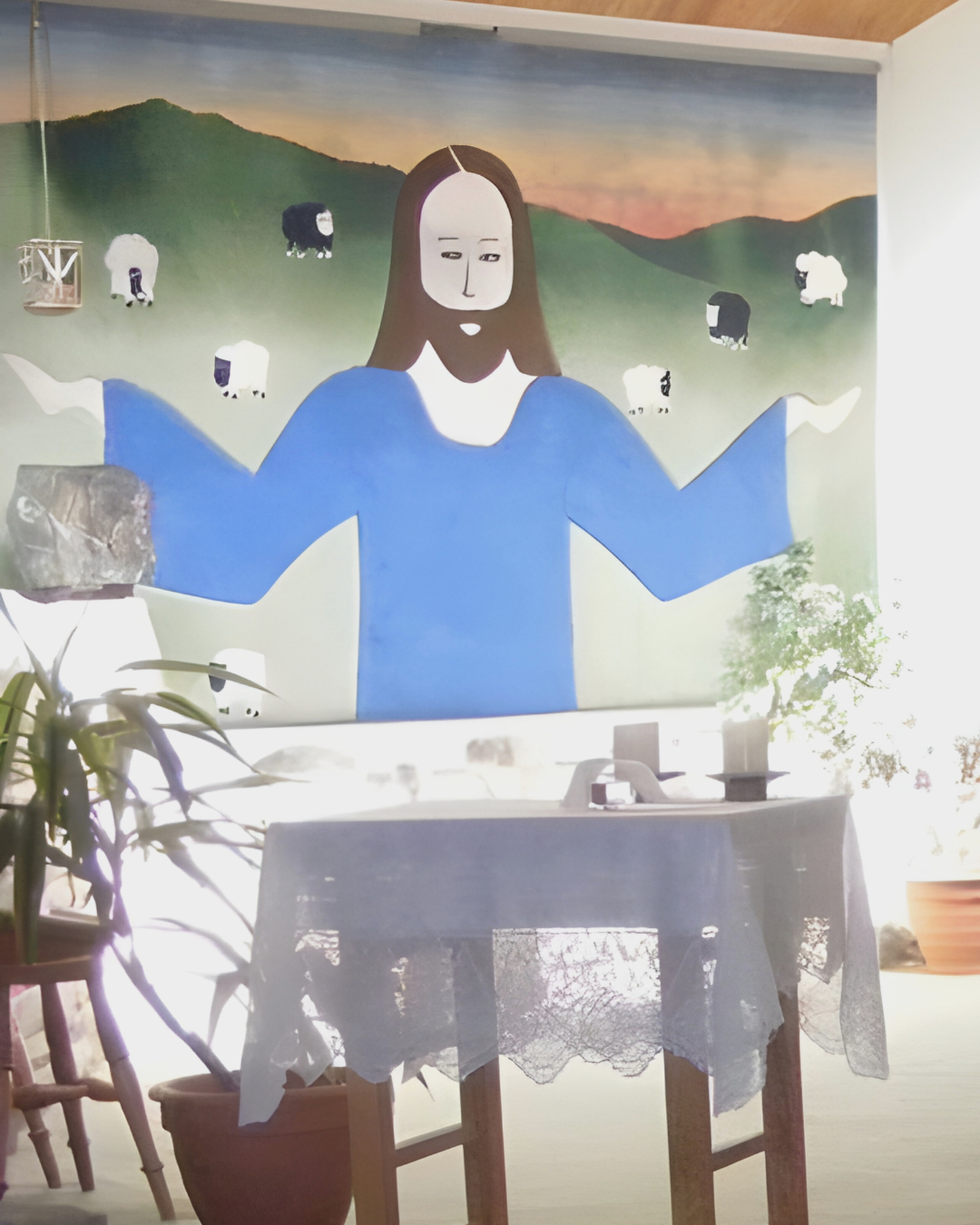 The Church of the Good Shepherd, Mytholmroyd
 Janet Symes and Carol Burns - post-film discussion
 Leeds Palestinian Film Festival
The film was a little over an hour so there was ample time for a post-film discussion with questions. Janet Symes, formerly head of the Middle East and South Asia desk for CAFOD provided some excellent reflection on the film and did her best to answer peoples’ questions. It was striking that some in the audience had completely missed the point about the nonviolent approach – one person describing it as ‘misguided’. It is not just Hamas and the Israeli Government who seem to think that violence can solve this situation! However, this made it all the more worthwhile for SPARK to have shown this film.
Leeds Palestinian Film Festival
The film was a little over an hour so there was ample time for a post-film discussion with questions. Janet Symes, formerly head of the Middle East and South Asia desk for CAFOD provided some excellent reflection on the film and did her best to answer peoples’ questions. It was striking that some in the audience had completely missed the point about the nonviolent approach – one person describing it as ‘misguided’. It is not just Hamas and the Israeli Government who seem to think that violence can solve this situation! However, this made it all the more worthwhile for SPARK to have shown this film.


 Rev Ashraf spoke with passion about the history of the region and his own history. He said that his ancestors were living in the region when Jesus was alive and so he can trace his ancestry to the earliest Christians.
 A prayer bookmark from
  I must give a mention the first part of the event. This was a middle eastern lunch supplied from

 The film this year has been chosen by the Leeds Diocese Pax Christi group in consultation with the Film Festival committee. It is called “There is Another Way”. The film follows the members of Combatants for Peace. This organisation, nominated for two Nobel Peace Prizes, is an extraordinary bi-national group of former enemy combatants - Israelis and Palestinians - working together during an ongoing armed conflict. Confronted with the devastation and escalating violence of October 7th and the war in Gaza, the very core of the movement faces great challenges in showing that there is another way. The first question they must move past relates to their own beliefs...is this possible?