One of the greatest gifts my mother gave me very early in life was the ability to read. I could read before I got to primary school at five, but, regrettably,was a disruptive child in the class until a teacher, to whom I'm eternally indebted, pulled me out and sent me with an exercise book and pencil to the public library to study on my own for a day. It couldn't happen now of course but that day inculcated in me a lifelong love of libraries and books.
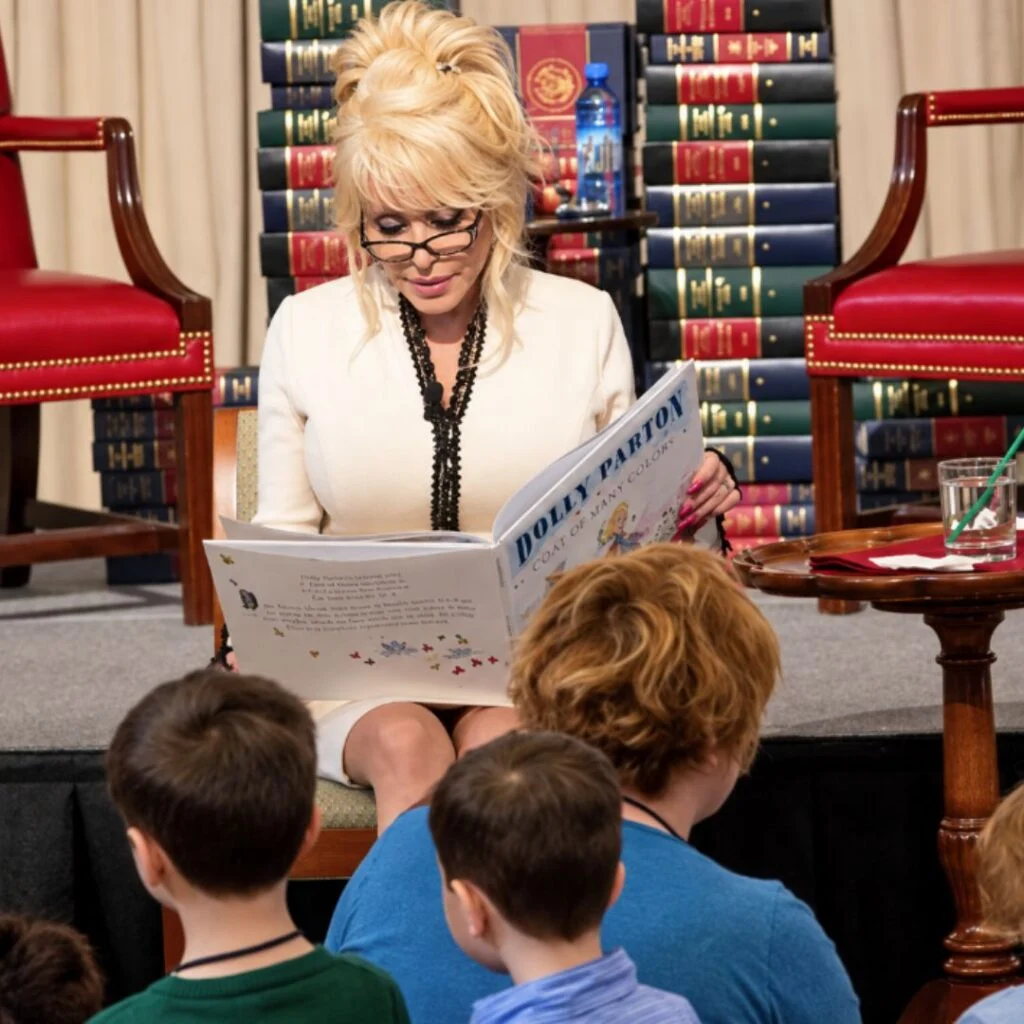
Amid the usual bleak news and daily tragedies this last month emerged an enheartening story in the reports of the death of the country singer Dolly Parton. She founded a charity the "Imagination Library" in honour and memory of her Father who was illiterate, that distributes free books to children from birth to the age of five.She started it in her home of Tennessee and it has since delivered over 300 million books worldwide, including supporting a reading project in Doncaster in the UK. The Imagination Library has been described as the biggest philanthropic contribution to literacy since Andrew Carnegie's libraries.
Here the award screen and children's writer Frank Cottrell Boyce, who from 2024 was the children's laureate, has made a huge contribution to encourage in reading, not least through the charity The Reader Organisation, championing a return to books for young people in the digital age.
Paradoxically, this is in the face of huge increases in the number of books published. In the UK over 177,000 books a year are now published, the largest expansion since 2005. Some 190 million books were sold in the UK in 2025, yet there has been a real decline in the sustained voluntary reading of printed books. In the USA, only 45% of the population read at least one book a year. a decline from 61% in serious and leisure reading, though there has been a move to audio and e-books.
In the UK, it is children's reading that is in serious decline.The National Literacy Trust spells out that since 2005, it has fallen from 38.1% to 18.7%.
Fewer young people are picking up books and are rather fixed onto their digital devices and screens watching videos, gaming, streaming, podcasts and sometimes e-books and audiobooks.
In 1985, Neil Postman in "Amusing Ourselves to Death: Public Discourse in the Age of Showbusiness" warned of the impact of TV on our society's abilities to be attentive. Now social media has greatly amplified the impact of the delivery of quick, short time attention 'moments', presented in bite-size chunks. James Marriot cites the prescient remark of the 18th century literary giant Samuel Johnson: "People in general do not willingly read if they can have anything else to amuse them."
Interestingly, Marriott goes on to refer to the work of Fr Walter J Ong SJ whose "Orality and Literacy: The Technologising of the Word" (1982) suggested that without writing and reading societies become "agonistically programmed", with an inherent bias towards confrontation. Walter Ong wrote "not only in the use to which knowledge is put but also in the celebration of physical behaviour, oral cultures revealed themselves as agonistically programmed", that is as competitive and contest orientated. He proposes that reading and writing "foster abstractions that disengage knowledge from the arena were human beings just struggle with one another".
Reading therefore can be an antidote to conflict and violence.
The American writer George Saunders suggested that:
"reading is a form of prayer... a guided meditation that briefly makes us believe we are someone else, disrupting the delusion that we're permanent and at the centre of the universe... suddenly (we're saved), other people are real again and we're fond of them.".
The idea of "reading as prayer" is long-standing in the Christian tradition.
Erasmus regarded reading the Gospel as a form of prayer, as through the text Christ becomes present to the reader. The ancient prayerful practice in the Church of "Lectio Divina", with its roots in early monasticism, encourages us to treat reading as prayerful reflection on the Scriptures, and to treat the text not as a source of new knowledge but as a personal transformative interaction. Of course it matters what material we read but perhaps it's a time to turn again to quiet personal reading of the Scriptures as a contribution to the continuation of the practice of reading.
In an age where entitlement, pride and greed are normalised and even promoted - to the detriment of our planet, our societies and even our own souls - it is worth asking ourselves a simple question, following Socrates’ ancient admonition that “the unexamined life is not worth living”.
The question(s) I’d like us to ponder are: What is our purpose in life as human beings inhabiting God’s creation? Besides the why - which might be an entirely different discussion - what have we been created for?
I have some answers of my own, however I would very much rather you critically and carefully explored yours in light of the Word of God to come to your own conclusions.
We see in Genesis that, as God’s ‘image bearers’ (Genesis 1:26-27), we are tasked (and honoured) with the responsibility to work/cultivate/serve and keep/watch over the garden of Eden, God’s original and perfect creation of which we are an integral part (Genesis 2:15).
I think it’s fair to say that we all know how the story unfolds in following chapters. However, if you don’t know yet, or if you need a reminder, feel free to read the rest of chapter/book. Much of the time since then our understanding of our role within creation has focussed on domination rather than stewardship or more, seeing ourselves as part of and in relationship within the whole web of creation.
Fast forward a couple of ages, and we find ourselves with the fullness of revelation, Jesus Christ, God Himself, the Son of Man who “did not come to be served, but to serve […]” (Matthew 20:28, Mark 10:45). The very Person by whose breath we have received and keep ours, lived among us, in the same broken and challenging world and “[…] did not count equality with God a thing to be grasped […]” (2 Philippians:6-7), choosing forgiveness, humility and service over self-interest, grandiosity and greed when He quite literally had every right and authority over life itself.
What does that tell about us about the tendencies of our world, our own ways and ourselves? Of course, given our brokenness and capacity for sin, it’s natural for us often to want more than we need, to feel that we are owed the things we so easily and regularly take for granted and to look to advance our own interests and agendas. But is that all there is to human existence? Are we simply here to follow our more base and natural desires and inclinations even at the expense of our neighbour, our future generations and the whole of creation? Or can we realise that God calls us into right relationship with the whole of God’s creation?
We are clearly seeing how the consequences our selfishness endangers not only the whole planet with high levels of land and marine deforestation and pollution, but also all its inhabitants, human and non-human alike. We also see how this self-centred, vainglorious and grandiose image we hold of ourselves as “supreme rulers of the earth” plays out against ourselves the very moment we remove or fail to acknowledge God’s sovereignty and true authority thus causing us to disregard His will and to extend our destructive tendencies outward onto each other and the created order.
I firmly believe we can and must do better with and by the Grace of God. For the sake of ourselves, for the sake of the created order and for the greater glory of God in the name of Jesus Christ. Amen.
The last few weeks have featured the seasonal reporting of the exam results for the majority of the 16 and 18 year olds in the UK. Great fuss is made of the improving results and the joy of those who have achieved the grades they wanted. But what about those who are disappointed? Yesterday, following the death of Dolly Parton, reporting was about literacy and the high number of adults in the UK who struggle to read.
State education was introduced to enable those from poorer backgrounds to increase their learning and earning. Yet after 100+ years it is apparent that the exam results achieved in the poorer areas in the country significantly lag behind those in more affluent areas. Why is this so? One reason may be that the exam Boards were originally created by Universities to enable them to select on merit those who would benefit most from their ongoing studies. There was a system of vocational qualifications established by different industries and occupations and employers expected their new staff to complete such occupational qualifications.
In my day 1 in 10 18 year olds went onto further academic study. 1 in 6 students were girls. Now a much higher proportion of 18 year olds continue to study and the gender split is approximately 50/50. Major employers and the Forces would sponsor the brightest students who would gain work experience in vacations and be expected to join their workforce for a period post graduation.
But many occupational qualifications, such as teaching, physiotherapy, radiography, nursing and other public sector jobs now require a degree. Yesterday a women explained how she felt ‘thick' at school because she struggled to read, but having raised her children she wanted to be a midwife so she went to the local college and spoke to them. They helped her to improve her reading and do an access course and she is now a midwife. Two of my daughter's friends who received Educational Maintenance Allowance due to low family income, went to University to do Childhood Studies. They graduated with Student Debt. On graduation one decided to work in a Nursery, the other as a Teaching Assistant. They then did courses at FE College that they could have done at 18……..
Not everyone thrives in the education system but that is not a reflection of their ability to do a professional job.
I think there is a dissonance between a system that aims to produce great academic results to age 18, defining and measuring and monitoring the achievements of each pupil and within which the teachers are adamant that such a judgemental regime, OFSTED, should not apply to their performance. Seems hypocritical to me. I ran many courses for managers regarding performance management and the accent was always on identifying an individual’s strengths and assigning work that played to those strengths. It marries knowledge and skill but still recognises that within the workplace there is some flexibility on how a task is done. It was so important that everyone felt their worth was recognised so they were motivated. It seems to me that our education does not create that sense of worth which can lead to disengagement.
About 15/20 years ago Julie was made redundant from her job managing a team of 50 people. She found work as a learning mentor in a senior school and loved it. One of the teachers encouraged her to qualify as a teacher and get paid more. She decided to go to University and do a degree in Business Studies followed by a Post Grad Certificate of Education. She was puzzled when she attended the interview for the PGSE because the first stage was that she was asked to write the story of her journey to the interview. She did so. At the end of the interview she was asked if she had any questions, she queried why she had been asked to write the story. She was told that it was a good way for them to weed out the graduates who could not write in grammatical sentences and explain something simple in good English!
About 20 years ago when I worked in the security industry, at the time it was believed that about 25% had poor literacy, we used that test on job applicants to check that they would be able to read enough to pass the mandatory test that they needed to go on site and work.
Gary left school at 16 to work on a factory production line. He decided to do Maths and English GCSEs when his children started secondary school. A College tutor recommending he considered a teaching degree via an Access Course as he felt he had the ability to be a good teacher. He went to Uni and spent some time as a primary school teacher.He now works in an FE College teaching the students whose English and Maths is holding them back from passing their occupational qualifications. He uses the same techniques as were used in their primaries but these pupils can be more motivated to learn once they see the purpose of such learning.
Our system is failing too many of our young people. I pray that the discussions around the work being done by Aslan Milburn will continue to look at the way the whole system works and gain the traction and funding needed to create pupils who understand their worth, their abilities and what motivates them so that they can progress to adulthood feeling engaged in society and positive about their future.
One of my favourite bible passages is about how Jesus intervened in the case of a woman who had been caught in adultery. According to Jewish law her punishment was to be stoned. The male Scribes and Pharisees wanted Jesus, who had been preaching about love and forgiveness, to confirm his support for the Law. However Jesus said ‘Let anyone among you who is without sin be the first to throw a stone at her.’ And bent down and gave each of them an example of their own sinfulness. No stone was thrown. The woman went away with the message that she should sin no more.
When we blame someone else it often means that we are not considering our own role in whatever has happened. Migration has always been feature of human existence. Yet across the world migrants are being blamed for problems within the societies they now live in. The language of blame is spreading throughout politics. Economic woes within the UK are down to poor growth and the off-shoring of many jobs that used to be the providers of growth.
I grew up in Warrington and there were several large manufacturing works who provided most of the local employment; the wire works (hence the rugby league team name of the Wires, now the Wolves), cotton mills and clothing manufacturers, the box works, tanneries, gas cooker manufacturers, train making, Persil manufacture, brewers and the distillery. Only gas cooker manufacture is still a big employer. The warehousing, call centres and small businesses will never replace their contribution to the UK economy. That work is now done in other countries.
Recent migrants are not responsible for that change. Business managers will move their investment to areas where production is cheaper meaning their return on investment (profit) is greater. That’s capitalism. In the short term we had more choice when we spent our money and everything looked rosy except for those who never found another well paid job and who lost hope. Especially when their children found good jobs hard to come by.
Unfortunately some politicians have blamed recent migrants for our current economic woes and many of those who feel forgotten or unacknowledged by the ‘’Establishment’ like that message because it sounds like such a simple solution if we send them home. I feel that this misinformation threatens our democracy.
We need to own up to both the impact of decades of underinvestment in growing manufacturing and exportable services to provide well paid jobs throughout the country and acknowledge the impact of years of ‘austerity’ on Public Services that allow so many people to ‘fall through the gaps’ in services which have been reduced by the impact of inflation.
For example, this morning I went to see a Council tenant who had a kitchen fire 4 months ago. Smoke damaged all the furnishings. Temporary accommodation was provided for that night but the expectation was that they would move back in the next day after Council workers had disposed of the furnishings and washed the walls and ceilings. They left the burnt out kitchen appliances and removed a fuse so the kitchen plugs wouldn’t work. The Council will start work on her replacement kitchen on Monday. It has taken the intervention of her Town Councillor to get these repairs started.
Round the corner, a family were re-housed and given a garden that their children, one of whom was disabled, could play in. The Council promised to replace the fencing so that it was safe for the children. Nothing was done. The parents' complaints weren’t actioned and they appealed to the Ombudsman who found in their favour. By that time they had had a whole summer where they couldn’t let the children into the garden without supervision.
I find it easy to understand why people with similar life experiences and an ‘uncaring’ State (despite the hard work and dedication of many public servants who often bear the brunt of such dissatisfaction) listen to messages of blame and may vote for those who appear to offer quick solutions.
I hope that Alan Millburn’s second report and recommendations for supporting the young people not in education, employment or training who have often grown up in households in poverty will help the Government to address the lack of good jobs so that school leavers in Warrington, and similar places, will aspire to move into well paid jobs as they could have done 50 years ago.
His first report was clear that our economy has been struggling for growth for decades and that it is time that we looked at new ways of engaging with the way we work together to give children from poor households decent job prospects that enable them to break the cycle of poverty. This is too important to let party politics stop the changes that are needed.
I hope that the Government and Mayors will pay more attention to rates of complaints and of successful appeals as a way of measuring how the public sector is performing. I am sure that such a change would help us to have more informed dialogue about what the people’s priorities are and where services need to change. Telling us how much more they are spending doesn’t give any indication of effectiveness!
And blaming migrants doesn’t help us to reduce poverty and become a fairer society.
I take hope from the millions of quiet conversations that take place around the world where people listen to each other and generate ways to improve the lives of their communities, especially for those who are struggling the most. I am sure that the majority of such conversations go unreported on socials and news media.
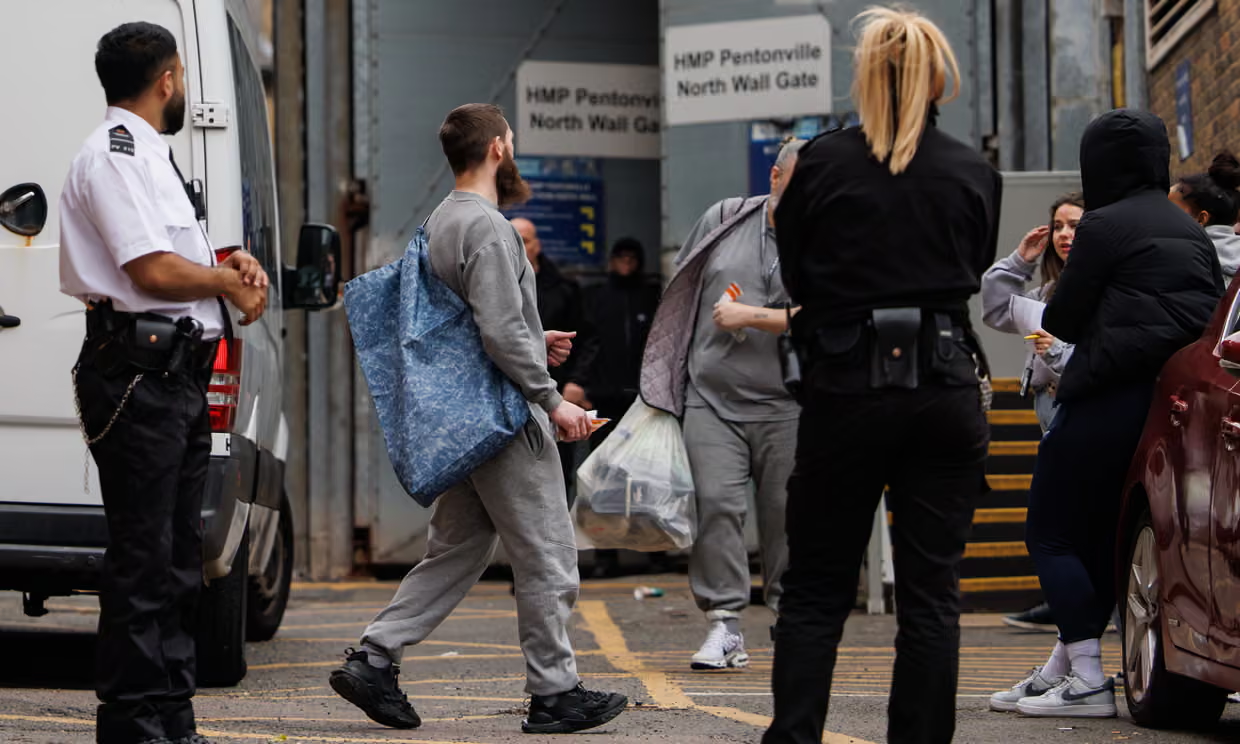
Yet when I look at BBC News or read a newspaper or listen to the radio I see a different picture. This morning there was talk of the very high number of people signing an on-line petition to keep the two men in jail for the manslaughter of PC Harper in jail rather giving them access to the next round of early releases. In connection with that, I have heard several discussions about the categories of prisoners that will be released and the statistics about their chances of re-offending. Sadly, domestic abusers and sexual predators will be eligible for earlier release even though their re-offending rates are high. It would seem that the decision was made based on the number of places that could be freed up rather than the risk posed to the vulnerable?
This Government has a Minister for Women and Equalities. I also take hope from the raised profile of the need to reduce and eliminate gender based violence since the first appointment was made. As a woman, it seems to me that we need both to protect our women and girls and our Police, emergency services and other public servants who we empower to act in our name. As such the likelihood of re-offending should factor in early release decisions.
Recent statistics have also shown that on average across the UK people are getting younger when their health starts to fail despite the extra money invested in the NHS. Most reporting is on the length of waiting lists which seems to be where money is being spent. I understand that there is an increased focus on improving public health. I take hope from the questions asked in a poll I completed that asked me to rate whether we should fund dentistry to ensure that most people can maintain functional teeth or fewer people have straight white teeth. I opted for the functional teeth. I hope that influences where investment in NHS dentistry is going.
As a country we face enormous challenges from the influence of big tech firms whose platforms are designed to generate advertising income. It is clear from recent USA Court Cases claiming damages for the harms done when the platform design accentuates negative posts that, particularly for young people, mis-inform and mislead. However such findings are always appealed.
I take hope from that fact that Governments around the world, including ours, are taking action to force the platform designs to reduce harmful content. Surely the aim has to be on safer design? As a teenager I placed more weight on what my friends said than anyone else, so a ban on access to harmful content until the age of 16 isn’t the full answer.
We have much to be thankful for and hopeful about.
I was contemplating life, the universe and everything while watching the river Thurne when I noticed hundreds of seeds, floating from left to right with the tide. The ducks were paddling against the tide and eating many of them. Some seeds blew across the river and landed on the river bank, some on the green grass close to the river’s edge and some a bit further away onto the very yellow parched grass. A while later the direction of the tide changed and they changed direction.
It brought to mind the fragility and randomness of life and the recent gospel about sowing seeds. I like to think I like to think that I heard the message Jesus intended for us, the seed in the soil. The Jesus I follow consistently reached out to the poor and marginalised people, he believed in equality of opportunity. He also tells us that we are each a unique individual in the image of God , and we are much loved by God. As a follower of Jesus that means I must respect the dignity and worth of every single person. I therefore struggle to understand how some fellow Christians seem to believe that it is OK to treat some people detrimentally just because they look different or act differently. Slavery is one example of this behaviour.
It is noticeable that over time the notion of equality of opportunity has become embedded in some societies. After all, both religions and political parties are groups of people with strongly held beliefs that they enact the rules under which their community lives. Those rules lead to accepted behaviours that are visible. The underlying beliefs are not as apparent.
I feel I have more in common with those believers of other faiths who also interpret their Holy texts as promoting the way of love and equality than I do with the fellow Christians who seem to interpret the Good News to allow them to exploit and discriminate against other groups of people. I feel it is dangerous when faith leaders openly support politicians who are promoting divisive policies that breed hatred and ignore injustice and intimidation within their community.
I then saw a photo of Benita Bowlding, a young black woman, in a newspaper. It was taken on Independence Day this year. She is sitting on a crowded metro train in Washington surrounded by members of the Patriot Front. They were white, wore baseball Patriot Front caps and masks so they could not be identified. They were travelling in connection with a march through the streets and had not sought permission from the authorities. The administration did not condemn the march or seek to interfere. Their silence can be seen as granting the Patriot Front permission to continue to act in such an intimidating way. The history of the rise of Nazism in Germany teaches us that over time a community that was settled and diverse can become divided and fearful because people are afraid to challenge.
I believe that in a just society Free Speech has to be limited to protect minorities from such intimidation. For me that is what Jesus tells us. In the UK we have limits on what is classed as acceptable free speech and our independent Courts make decisions where there is a dispute. I am thankful that we have such checks and balances. For me democracy relates to the structures of the way power is challenged within the administration, it is more than the one person/one vote system. I am so thankful that I live here in the UK.
Just as I feel closer to people of other faiths who think and act like me, I feel closer to countries who have control and command structures as well as independent structures of checks and balances. Without those a democracy can become more like a despotic regime. As a woman I experience vulnerability.
When I was a teenager, my parents warned me that I would be judged by the friends I spent time with. In Europe we have centuries of experience of Diplomacy and Foreign Policy, of gaining and losing Allies. I hope that our Government will continue to seek to influence those allies who overstep the boundaries of what we consider to be right and just and to step aside from action that we feel does not fit with our values of tolerance and equality.
I pray that our Pope and clergy will continue to speak out, promote and support a world that is more equal.
BradfordCND supporters will gather in Norfolk Gardens (behind the Town Hall) to remember the nuclear bombings of Hiroshima and Nagasaki – all welcome to join. Contact: For any queries please contact 01274 730795 or email info@yorkshirecnd.org.uk
Thursday, 06/08/2026 - 13:00 - 14:00
Sheffield
CND supporters will gather in Tudor Square to remember the nuclear bombings of Hiroshima and Nagasaki – all welcome to join.For any queries please contact 01274 730795 or email info@yorkshirecnd.org.uk
Thursday, 06/08/2026 - 11:00 - 12:00
Manchester
The event will start in the Living Worlds Gallery in Manchester Museum at 11am where a piece of melted glass from the Hiroshima attack is on display along with hundreds of paper cranes, the symbol of peace that came out of the attack. We will then move upstairs for readings, poetry and some choir singing. Organised by: Manchester City Council with support from GMD CNDVenue: Manchester Museum, Oxford Road Manchester M13 9PLContact: For any queries please contact 07840 303539 or email gmdcnd@gn.apc.org
Saturday, 08/08/2026 - 14:30 - 15:30
Hebden Bridge
CND supporters will gather on the Wavy Steps by Packhorse Bridge to remember the nuclear bombings of Hiroshima and Nagasaki – all welcome to join.
Sunday, 09/08/2026 - 10:30 - 11:30
Leeds
CND supporters will gather in Park Square to remember the nuclear bombings of Hiroshima and Nagasaki – all welcome to join.
Sunday, 09/08/2026 - 14:00 - 15:00
Manchester
Greater Manchester & District CND invites all our friends and supporters to join us to commemorate the 81st anniversary of the Nagasaki atomic bombing. The event will take place in Heaton Park by the peace tree behind the Stables Block.
There are many groups all over Leeds doing amazing things - connect with them and get involved with their work!
Green Futures speak on behalf of their youth group: (photo courtesy of Ilze Millere)
I was at the Civic Hall in Leeds at a crucial climate event, days before the heat wave hit Leeds. The focal point was a screening of a new film called The People's Emergency Briefing, about the climate and nature crisis and what it will mean for life in the UK.
The screening followed the publication of new research by Leeds-based climate scientists which warned that the Earth is accumulating heat at an accelerating rate. The film highlights the scale of the challenges we are facing with the climate crisis, the loss of biodiversity and the damage to rivers and our environment.
Stand out speakers included representatives from Beeston’s Green Futures youth group who pointed out the UK has a big part to play in turning around the climate and nature crisis we are in. They spoke directly to the MPs and local councillors attending
“Today, you are all sitting here as decision makers with the power to create a difference. Go greener, go further.”
The People's Emergency Briefing film features Chris Packham and includes leading experts in climate science, nature, health, economics and national security. The film clearly sets out what the climate and nature crisis means for everyday life in the UK; our discussions afterwards focused on local solutions and how we can all work together.
What can you do now to make a difference?
We are talking to Anne-Lise Lancaster, lead organiser of the event from Climate Action Leeds, about hosting a local screening with SPARK and the Justice and Peace Commission. Get in touch if you want to be part of a small planning group and learn event planning skills - or just let us know what you would like to see at an event like this.
“Love is the will to extend one's self for the purpose of nurturing one's own, or another's spiritual growth”
M. Scott Peck
A lot has happened in my life in the last three months including the death of my beloved father and being made redundant. These two unexpected losses have really stopped me in my tracks, and made me consider my faith as well as my vocation as an artist and community organiser.
My parents were both great advocates of creativity and supported me and my two brothers study Fine Art at university and to use our creativity for the common good. My father and I recently published co-written poetry and enjoyed sketching together as a way to share the old, and ancient, stories from his childhood home on the shores of Lough Neagh, County Tyrone in the north of Ireland. I miss them both deeply, and whilst I am in the process of developing my artist practice as a freelancer I think of their belief in me that I should use my art and commitment to justice and peace for the benefit of others.
In taking some time to heal, I have read several faith, art and inspirational books including bell hooks’ bestselling book ‘all about love’ which is helping me put things into perspective and feel comforted by her words of wisdom.
‘all about love’ published in 1999, is a cultural critique and self-help book that diagnoses modern society as suffering from a pervasive ‘lovelessness’, driven in part by consumerism and in her writing, she argues that because society fails to define love properly or provide clear models for it, people struggle to build healthy connections.
It was released for sale when I was in my final year at Liverpool Hope Art College training to become a Fine Art printmaker, and I wish I had known about it back then, as so much of my creative practice would have dovetailed to her writing.
I was first introduced to bell hook’s work when researching for a creativity retreat I delivered called ‘Creativity Catalyst’ back in 2022 which reflected on the Christian church’s role in the trans-Atlantic slave trade, and later in a case study I commissioned in 2024 with Leeds Beckett University looking at creative pedagogies in a Leeds faith based school. The lead researcher, Dr Lisa Stephenson quoted bell hooks throughout her final report on children’s dispositions and capacity for love, hospitality and welcome expressed through drama, creative writing and sculpture.
bell hook’s writing has a gentle force to encourage community organisers like myself, to shed the overwhelming complexity and distractions of modern consumption. Through her own lived experiences she describe how we can free up the emotional and physical energy needed to truly care for, respect, and know others. “Simplicity strips away our reliance on excess, allowing us to be present.”
Her inspiration is not merely in her writing, as she opted not to capitalise the spelling of her name, hoping to keep the public’s focus on her work. But over her decades at the forefront of Black feminist writing, the punctuation choice became a constant curiosity.
I feel like making the decision to read ‘all about love’ has helped me to challenge my views linked to the popular notion that love is merely a feeling. Instead, she described love as an action, a choice and a commitment to nurture our own and one another's spiritual growth. Her vision resonates strongly with the Gospel commandment to ‘love your neighbour as yourself’ in and offers a powerful framework for anyone seeking to work for justice and peace. These words are foundational to Christian ethics and Catholic Social Teaching, especially the two pillars of solidarity and subsidiarity that help navigate my own decision making.
Looking back over the past quarter century since ‘all about love’ was published, I can see how my own understanding of agape, self-sacrificing, love has influenced my work in the Catholic Diocese of Leeds as Community Participation Coordinator for CAFOD for 7 years, and more recently as Faith and Creativity Lead at Leeds Church Institute. Whether supporting parish communities, engaging with campaigns for global justice, or creating spaces where art and faith meet, I have been drawn to the conviction that social transformation begins with relationships rooted in dignity, compassion and solidarity.
The call to ‘live simply’ has been another thread running through both my faith and professional life. For hooks, love requires us to challenge systems built on domination, greed and inequality. Similarly, Catholic Social Teaching reminds us that our choices have consequences for our neighbours, especially those living in poverty and those most affected by environmental destruction.
This connection became particularly evident through conversations around climate justice and climate racism. The communities who contribute least to climate change are often those who suffer its harshest impacts. I have delivered creativity retreats for clergy and lay faith leaders on climate racism using the inspiration of Yinka Shonibare’s ‘Hibiscus Rising’ which exposes the unequal burdens carried by poorer nations and marginalised communities, reminding us that environmental issues cannot be separated from questions of justice, power and human dignity. To respond faithfully requires more than concern; it requires love in action.
These themes have also found expression through the Art Theology Festival, where Leeds based artists Janet Freckleton and Luke Walwyn, theologian Dr Tasia Scrutton, Leeds Craftivists and local communities have explored how creativity can help us imagine more just and hopeful futures. Art has the unique ability to connect head and heart, helping us see our neighbours differently and inviting us into deeper relationships with one another and with creation itself.
As a young graduate from Liverpool Hope Art College, I was inspired by the ecumenical witness of Bishops David Sheppard and Derek Worlock, whose leadership in Liverpool demonstrated the transformative potential of faith working for the common good. Their commitment reflected the vision of the landmark report Faith in the City, which challenged churches to engage seriously with poverty, exclusion and urban injustice. Those influences helped shape my understanding that faith is not something lived privately but expressed through active participation in the life of our communities.
These insights also echo the teaching of Pope Francis in Laudato Si', where he reminds us that "everything is interconnected". Care for creation, concern for the poor, and commitment to the common good are not separate tasks but part of a single vocation to love.
As Francis writes,
"We are not faced with two separate crises, one environmental and the other social, but rather one complex crisis which is both social and environmental."
As I look ahead to the next stage of my journey, I remain grateful for the writers, church leaders, communities and colleagues who have helped shape my understanding of faith in action. Twenty-five years on from graduation in Fine Art I am still learning that the most important creative work we can do is to practise love, not as sentiment, but as a way of living that seeks justice that builds a more compassionate world for all. I will be leading creative retreats in September for clergy and lay faith leaders alike, using fine art techniques to encourage dialogue on some of the hardest to talk about social injustices facing our communities today.
Keep an eye on my Instagram for dates and booking information.
To provide the best experiences, we use technologies like cookies to store and/or access device information. Consenting to these technologies will allow us to process data such as browsing behaviour or unique IDs on this site. Not consenting or withdrawing consent, may adversely affect certain features and functions.
Functional
Always active
The technical storage or access is strictly necessary for the legitimate purpose of enabling the use of a specific service explicitly requested by the subscriber or user, or for the sole purpose of carrying out the transmission of a communication over an electronic communications network.
Preferences
The technical storage or access is necessary for the legitimate purpose of storing preferences that are not requested by the subscriber or user.
Statistics
The technical storage or access that is used exclusively for statistical purposes.The technical storage or access that is used exclusively for anonymous statistical purposes. Without a subpoena, voluntary compliance on the part of your Internet Service Provider, or additional records from a third party, information stored or retrieved for this purpose alone cannot usually be used to identify you.
Marketing
The technical storage or access is required to create user profiles to send advertising, or to track the user on a website or across several websites for similar marketing purposes.











 Thursday, 06/08/2026 - 13:00 - 14:00
 Thursday, 06/08/2026 - 11:00 - 12:00
 Saturday, 08/08/2026 - 14:30 - 15:30
 Sunday, 09/08/2026 - 10:30 - 11:30
 Sunday, 09/08/2026 - 14:00 - 15:00
 Green Futures speak on behalf of their youth group: (photo courtesy of Ilze Millere)
I was at the Civic Hall in Leeds at a crucial climate event, days before the heat wave hit Leeds. The focal point was a screening of a new film called The People's Emergency Briefing, about the climate and nature crisis and what it will mean for life in the UK.
Green Futures speak on behalf of their youth group: (photo courtesy of Ilze Millere)
I was at the Civic Hall in Leeds at a crucial climate event, days before the heat wave hit Leeds. The focal point was a screening of a new film called The People's Emergency Briefing, about the climate and nature crisis and what it will mean for life in the UK.


