by John Battle May 2025 at Church HouseTwo recent distractions; hearing echo loudly in the Eucharistic prayer at Mass after the Consecration the phrase "together in the FULLNESS of charity" and seeing our new Holy Father Pope Leo XIV hold up a copy of his namesake predecessor's foundational encyclical" Rerum Novarum". (1891).
I have been trying to discern what does that "fullness of charity" mean in practice in our context? It goes much further than generous welfare action, charitable giving to those evidently in need or direct assistance. As "Catholic Charities" gathered here, how far are we being asked to go?
What extra do we contribute to our society? 
What for us today is "The Fullness of Charity" we are called to?
I start out from my own context today in Leeds working with local charities. In particular, St Monica's Housing Trust for single asylum women with "no access to public funds" until their papers and status as refugees is established. Also, in a local inner city neighbourhood New Wortley community centre in Armley in Leeds and at the now community-led successful social enterprise Bramley Baths. All three are charities registered with the national Charity Commission.
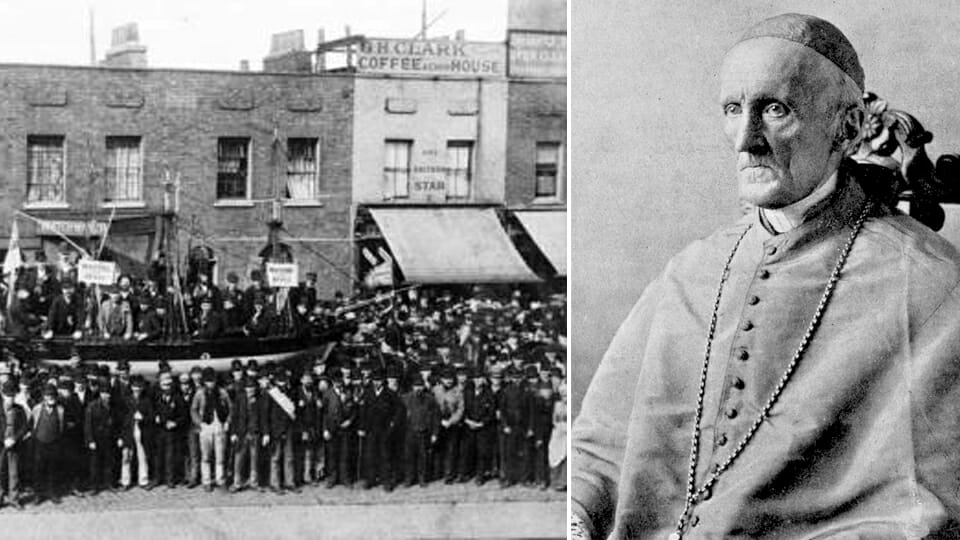
But before describing them, I want to recall a visit to Leeds on 28th Jan 1874 by Cardinal Manning. He is known as a champion of the workers and the poor in East London and the negotiator of the London dock workers’ strike. He came to Leeds and gave a lecture at the Leeds Mechanic Institute in the presence of the Mayor of Leeds on "The Dignity of work and Labour" referring to the developments of the Leeds textile industry, the treatment of workers and the impacts of poverty.
That lecture became a substantial part of the drafting and wording of "Rerum Novarum " Pope Leo XIII's foundational document for Catholic social teaching held up by the Holy Father at his first public Mass at the Vatican.

"Rerum Novarum" went through more drafts, revisions and redactions than other encyclicals (as the recovery of the draft documents in a box in 1940 revealed). It was a consultative may we say " synodal process" document.
Cardinal Ketteler of Mainz, Cardinal Manning and the French contribution Of Blessed Frederic Ozanam's St Vincent Paul Society organisation (which challenged the iron law of low pay and sent delegates of workers to Rome to petition the Vatican) were the major contributors to the encyclicals focus on workers' rights and tackling urban poverty.
Cardinal Ketteler from the heavily industrial Rhineland stressed the rights of workers to organise in trade unions and a legitimate role for the state.
Cardinal Manning focussed on the conditions of the industrial workers (not least in Leeds) and the impacts of poverty on families, pressing the case for a fair living wage and to eliminate dangerous child labour in factories.

The final text of “Rerum Novarum” was promulgated by Pope Leo XIII on 15th May 1891 - the anniversary is this month!
Cardinal Manning's contribution to "Rerum Novarum" in obvious in paragraph 3:
"By degrees it has come to pass that working men have been given over, isolated and defenceless to the callousness of employers and the greed of unrestrained competition... and to this must be added the custom of working by contract (think off the dock labourers hiring scheme each morning) and the concentration of so many branches of trade in the hands of a few individuals (think of the big five media giants) so that a small number of very rich men have been able to lay upon the masses of the poor a yoke little better than slavery itself".
How contemporary does that read and unpack in today's context! 
Pope Francis radically challenged us to realise that we are
not in an "epoch of change" but rather in a more fundamental "change of epoch". We really are in "new times" as the title "Rerum Novarum" (changed from early drafting of "The Dignity of Labour and Workers Rights") means.
Pope Benedict XVI in his encyclical "Caritas in Veritate" set the alert in 2009
“The complexity and gravity of the present economic situation rightly causes us concern; but we must adopt a realistic attitude as we take up in confidence and hope the new responsibilities to which we are called by the prospect of a world in need of profound cultural renewal, a world that needs to rediscover fundamental values on which to build a better future.
The current crisis obliges us to replan our journey, to set ourselves new rules and to discover new forms of commitment, to build on positive experiences and to reject negative ones. The crisis thus becomes an opportunity in which to shape a new vision of the future." (paragraph 21)
Reviewing "Rerum Novarum" for the Dublin Review, Cardinal Manning wrote:
"For a century the civil powers in almost all the Christian world have been separating themselves from the Church, claiming and glorifying in their separation. They have set up the State as a purely secular society and have thrust the Church from them. And now they find that the millions of the world sympathise with the Church which has compassion on the multitude rather than with the state or the plutocracy which has weighed so heavily upon them."
How remarkable has been the world reception much wider than the Church itself of the life and death of Pope Francis and the election of Pope Leo XIV.
The Church's contribution throughout the centuries through its communities, parishes, monasteries, orders and charitable institutions have long supported the needs of the people often prior to and in absence of default of state and powers. Once again, the Church in practice picks up the pieces! Plus ca change!
Significantly, "Rerum Novarum" recognises the importance of the contribution of the Church and its lay institutions to supporting civil society and social well being;
"The Church uses her efforts not only to enlighten the mind but to direct by her precepts the life and conduct of each and all. The Church improves and betters the conditions of the working men by means of numerous institutions". (paragraph 16)
Paragraph 19 continues:
"The efficacy of Christian institutions is marvellous and manifold ... there is no intermediary more powerful than religion, where the Church is the interpreter and guardian, in drawing the rich and working class together by reminding each of us of its duties to the other and especially of the obligations of justice",
Moreover
"The Church intervenes directly on behalf of the poor by setting foot and maintaining many associations which she knows to be efficient in the relief of poverty. Herein again she has always succeeded so well as to have even exhorted the praise of her enemies" (paragraph 29)

The quiet and understated role of our parishioners throughout the Covid pandemic not least expressed by the SVP local conferences organising home visits (contacts through windows!) and food bank support was not unnoticed by civic authorities who remarked how significantly Catholics were the practical leaders and most active personal supporters of others.
So, facing the future we have our guide of the Catholic social teaching tradition.Pope St John Paul II in his encyclical "Centisimus Annus" on the anniversary of Rerum Novarum stressed the need for breaking out of the state- market binary model insisting on the need to include and integrate civil society organisations.
Pope Benedict in his encyclical "Caritas in Veritate" spelt out that civil society is the most natural setting for an economy of gratuitousness and fraternity which fosters and disseminates solidarity and responsibility for the common good.
Pope Benedict introduced the concept of an "economy of communion", of caring and sharing
"Not merely matter of third sector but of a broad new composite reality embracing the private and public spheres one which does not exclude profit but instead considers it a measure for achieving human and social ends" (paragraph 86)

Bramley Baths now provides a beacon exempla of that new kind of reality. A partnership of people and the public and private sectors that is not for private profit. St Monica's models a new way of lay people providing very basic supportive services in a former presbytery.
But Pope Benedict tells us we need to go further in response to the call of the gospel:
"A sustained commitment is needed so as to promote a person based and community orientated cultural process of worldwide integration that is open to transcendence ("Caritas in Veritate" paragraph 47)
Not only must we ensure that our charities are both compassionate and professional, well governed and safeguarded but should contribute to building new relationships in imagination and hope, the new "mutual agreements" Pope Francis called for. Nor is it just an issue of regulated service provision.
Perhaps we need to be asking the deeper questions such as "What has the Charity Commission got to do with transcendence?”We need to "re-member" and reclaim the theological concept of "the fullness of charity" which cannot be reduced to "helping the poor". We are called, as Pope Francis reminds us in his last encyclical letter, “to work for a new humanity rooted in the love of Christ" ("Dilexit Nos").


 How will your church community mark this day in the Church's calendar? The theme that Pope Leo has announced is 'Peace be with you all: towards an 'unarmed and disarming' peace' As usual, Pax Christi in England and Wales has prepared a number of resources that can be used in a parish context. Use the button to find out more [themify_button bgcolor="blue" size="large" nofollow="no" link="https://paxchristi.org.uk/peace-sunday-2026/" target="_blank"]Pax Christi Peace Sunday Resources[/themify_button]

 In taking the name Leo XIV, the indications include a commitment to social issues. He is reportedly very close to Francis's vision regarding the environment, outreach to the poor and migrants.

