Donate
Diocese of Leeds Justice and Peace Commission (1)

15 May – Habemus Papam!

by Kathy Shaw, SPARK manager

Cardinal Robert Prevost has been elected pope and will be known as Pope Leo XIV

Pope Leo XIV holds dual citizenship in both the US and Peru where he served as a bishop. He spent much of his career as a missionary in South America where he is fondly remembered as a figure who worked with marginalised communities and helped build bridges in the local Church.

He is the first American to become pontiff and will lead the Catholic global community of 1.4 billion people.

pope-leo-xiv-050825-9-1f856aa9fabd4f97a913fde4974eb4f7 One of the first acts of a new pope is to choose a new name, changing their baptismal one. Over the years, popes have often chosen the names to refer to previous pontiffs for example, Pope Francis said his name honoured St Francis of Assisi. Once elected, the name that a chosen pope takes is often seen as a sign of their focus and direction for their papacy. It can signal continuity or a break with the past and suggest whether the new leader of the Catholic Church is progressive or traditionalist.

The previous Pope Leo XIII was pope at the end of the 19th century, he died in 1903. He was a determined defender of the rights of workers and is remembered as a pope who was dedicated to social policies and social justice. He laid the foundation for modern Catholic social thought, addressing workers' rights and capitalism at the dawn of the industrial age. He is particularly known for issuing an encyclical - a letter sent to bishops of the Church - called "Rerum Novarum", a Latin expression which means "Of New Things".

Rerum Novarum Robert Francis Prevost has a bachelor’s degree in mathematics. He was ordained a priest in June 1982 and studied canon law at the Pontifical University of St Thomas Aquinas (Angelicum) in Rome, five years later, he received his doctorate.

He was received into the Augustinian religious order in 1977. The Order of St Augustine was formed in the 13th century as a community of “mendicant” friars dedicated to poverty, service and evangelisation. It has a presence in about 50 countries, and its ethos includes a contemplative spirituality, communal living and service to others.

Pope Leo first went to Peru as a missionary in 1985, returning to the US in 1986 as vocations director in the Augustinians. In 1988, he returned to Peru for about a decade in the city of Trujillo, before returning to the US for a leadership role with the Augustinians in 1999. He returned to Peru in 2014 and was installed as the bishop of Chiclayo in September 2015. He also became a Peruvian citizen in 2015.

Pope Leo helping serve food In taking the name Leo XIV, the indications include a commitment to social issues. He is reportedly very close to Francis's vision regarding the environment, outreach to the poor and migrants.

Pope Leo was made a cardinal by Pope Francis in 2023 and appointed to a powerful position, responsible for selecting new bishops. Significantly, he presided over one of the most revolutionary reforms when three women were added to the voting bloc which decides on the bishop nominations sent to the Pope. He also supported Pope Francis's stance on allowing divorced and remarried Catholics to receive Holy Communion. However, he only showed mild support for allowing priests to bless same-sex couples.

As Cardinal he said in 2024,

"the bishop is not supposed to be a little prince sitting in his kingdom"

Appearing on the balcony of St Peter's Basilica, his first words outlined a vision of a "missionary" Church which "builds bridges, which holds dialogues, which is always open".

He also echoed his predecessor, the late Pope Francis, in calling for peace.

images (1)
Faithful God,

You guide us on the path of life

and your goodness is our constant companion.

Be with our new Shepherd, Pope Leo XIV,

in his service of the Church.

Fill him with the power of your Spirit,

the peace of your presence

and the compassion of Christ.

May he walk with you,

in wisdom and humility,

and lead us, together with all God’s people,

to embody your love for the world.

Amen.

A prayer to welcome Pope Leo XIV from CAFOD Director, Christine Allen

www.cafod.org.uk

12 May – Jubilee Debt Campaign

by CAFOD

Jubilee Debt Campaign in this Holy Year

As we mourn Pope Francis and pray for the new Holy Father, and the Cardinals, who will be gathering to elect a new Pope, we continue to celebrate the Jubilee Year Pilgrims of Hope. We recall that, in his letter for the Jubilee Spes non confundit, Pope Francis invited us all to be

“tangible signs of hope for those of our brothers and sisters who experience hardships of any kind.”

His model was the biblical Jubilee of the book of Leviticus. Taking place every fifty years, the Jubilee marked a great societal reset - land returned to its original owners, debts were cancelled, relationships restored, and creation renewed (see Leviticus 25). 

Cancel Debt Choose Hope We celebrate this Jubilee Year in a world where injustice, conflict and abuse of creation are sadly still prevalent. Just as the biblical Jubilee sought to transform economic and community life to reflect the values of God’s Kingdom, so we too are called to advocate for change today.

Central to this is the call for debt justice. In this Jubilee Year of Hope, Pope Francis called for richer countries to cancel the debts of poorer nations who are struggling with immense debt burdens, saying:

“More than a question of generosity, this is a matter of justice.”

CAFOD is part of a worldwide Caritas campaign this year calling for action on the global debt crisis. There is a petition that is being signed in 160 countries, calling on world leaders to take urgent steps in this Jubilee Year. You can sign the petition at cafod.org.uk/debtpetition and also invite others in your parish to sign by ordering paper copies at cafod.org.uk/cancelthedebt

As part of CAFOD’s parish materials there is a letter from Father Charlie Chilufya, a priest based in Kenya, to parishioners in England and Wales. In the letter Father Charlie explains the impact that the debt crisis is having on the Kenyan people, since Kenya is spending five times on repaying foreign debts as it spends on hospitals and schools.

“Families are foregoing medical care and children are losing access to quality education.”


Pope Francis spoke about the debt crisis and the need for action in the Jubilee Year many times in the last year of his life. Join parishes, schools and the whole Catholic community to respond to his call, at cafod.org.uk/cancelthedebt.

Finally, during May we will celebrate Volunteers week, and we give so much thanks to all volunteers in the Church.  You all make such a difference, and we couldn’t do what we do with you.

Pilgrims of Hope - Jubilee 2025

9 May – How Can We Support Gaza?


Practical Support, part of Pope Francis' Legacy

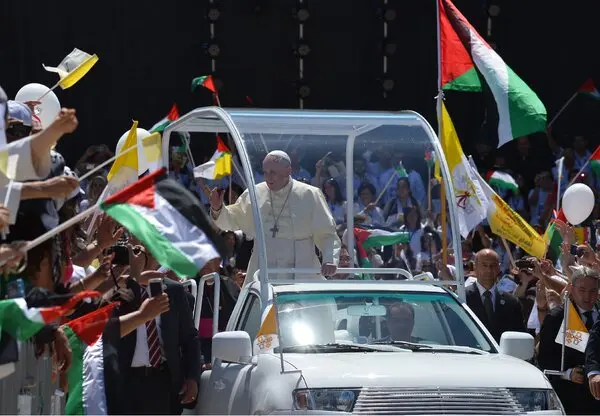
One of Pope Francis’s popemobiles is being transformed into a mobile health clinic for children in the Gaza Strip, fulfilling one of his final wishes, the Vatican's official media outlet said on Sunday.

The vehicle, used by the late pontiff during his 2014 visit to the Holy Land, is being outfitted with diagnostic and emergency medical equipment to help young patients in the Palestinian enclave, where health services have been devastated by the Israeli invasion.

Pope Francis, who died last month, entrusted the initiative to the Catholic aid organisation Caritas Jerusalem in the months before his death, Vatican News said. Peter Brune, Secretary General of Caritas Sweden, which is supporting the project, told Vatican News

"This is a concrete, life-saving intervention at a time when the health system in Gaza has almost completely collapsed. It's not just a vehicle. It's a message that the world has not forgotten about the children in Gaza."

The mobile unit will be equipped with rapid infection tests, vaccines, diagnostic tools, and suture kits, and staffed by medical personnel. Caritas plans to deploy the clinic to communities without access to functioning healthcare facilities once humanitarian access to Gaza is feasible.

Gaza has a tiny Christian community and Pope Francis phoned that little bombarded Catholic church almost every day, even during his illness.  How very sad that this much needed lifesaving gesture will have to wait until humanitarian and medical supplies can get to where it is needed most.

Popemobile in Gaza Join a conversation on the issue of non-violence with Palestinian activist and academic Mahmoud Zwahre and Andrew Rigby, Emeritus Professor of Peace Studies

Wheeler Hall, Leeds LS2 8BE

Buy Tickets

We Choose Non-violence - conversations with Palestinian activists

Illustrated with film by West Bank filmmakersIncludes updates from the West Bank and the significance of ‘Sumud’ in the Palestinian struggle.

Mahmoud Zwahre is a leading activist and organiser in popular non-violent resistance against settler violence in the West Bank and currently a scholar at Coventry University

Andrew Rigby has researched and written about unarmed resistance in the Occupied Palestinian Territories since the 1980s, activities informed by his deep commitment to nonviolence as practice and principle.

Doors open & refreshments 2.30pm

In Conversation

This is the first in a series of events which aim to provide a safe space where you can listen, talk, ask questions and find out more.

flyer image for event Host a Supper Club for Palestine this Summer

The Amos Trust are running a promotion for people to hold ‘Summer Palestine Supper Club’ event. 

Join them to honour Palestinian culture by bringing friends, family, or your local community together for a meal as an act of cultural resistance that supports the Gaza and West Bank appeal. Whether it’s a cosy dinner at home or a bigger gathering at a venue, it’s a simple but powerful way to stand in solidarity with Palestinians.

How it works:

  • Invite friends, family or colleagues for a meal
  • Cook a few simple Palestinian dishes (easy recipes on their website)
  • Ask guests to donate what they would spend on a meal out
  • Enjoy great food, conversation and solidarity
“Where politics has been the tool for Israel to divide us, culture has been our tool of uniting ourselves... and that’s why it’s really important for the solidarity of our friends to understand that, we are not that self-centric that we want to eat hummus all the time, but it has become a way of resilience and looking inward to ourselves, putting a nice warm jacket on ourselves by keeping participating and celebrating the cultural element of the Palestinians.” 

Mahmoud Muna — The Bookseller of Jerusalem 

Follow Amos Trust on Instagram for more recipe ideas

Palestinian Food

6 May – LIVESIMPLY EVENT PRODUCES A REAL BUZZ

by Joe Burns, Commission Member

Just over 50 people gathered at Wheeler Hall on the Bank Holiday weekend Saturday to find out more about the LiveSimply award scheme. It was a hectic day with 3 different workshops in the morning. In the afternoon people chose to attend another three workshops (out of 6 offered).

LiveSimply asks parishes to draw up a plan of action for

· Living more simply

· Living more sustainably

· Living more in solidarity with those experiencing poverty

Four parishes in the Leeds Diocese have already obtained the award with another 2 working towards it. After today there will be a number of others parishes seriously considering taking up the challenge.

Live Simply Care Deeply 3rd May event poster Christine Allen, CAFOD Director, was with us for the day and in a short presentation gave a context for the award scheme and then went on to lead morning workshops about living simply and sustainably. Francis Stewart, part of the CAFOD Theology team led another workshop about the underpinnings of LiveSimply – why should we see these sorts of action as stemming from our Catholic faith. The third morning workshop was led by Caroline Kelly, Head of the SVP Centre on York Road in Leeds, and she addressed the issues of those experiencing poverty.

The afternoon workshops were all geared around sharing ideas: what sorts of activities might encourage younger people to join in, how do you get started, how do you integrate the principles of LiveSimply into the liturgical life of the parish and so on.

Live Simply - Care Deeply Commission Chair, John Battle, summed up at the end and thanked people for coming along in the first place and for the enthusiastic way in which they had participated in the day. He pointed out that this was the first event in the Diocese where we had brought together CAFOD supporters, SVP members, staff from Caritas Catholic Care, younger people and J&P supporters to discuss the links (written about by Pope Francis in Laudato Si) between climate change and how this impacts most on people experiencing poverty.

The organisation of this event was a real collaboration with the parishes that already have the award and St John Vianney parish who are working towards it. The organising group will be meeting again soon to review what we do with all the actions ideas coming out of this day and decide on the best way of following these up.

Parish of St. John Vianney, Leeds - Progress review May 2025

  • We are approaching eighteen months since the start of our Parish Live Simply journey and our Action Plan is progressing well across all the nine individual actions.
  • Our initial target was to apply for the Award during 2025 and whilst this is still our intention, we are mindful that the real goal is not the award itself but for St John Vianney to truly become a ‘Live Simply Parish’.
  • How we really substantiate that progress, to both ourselves and the future Live Simply assessors to ensure that this not purely a ‘tick box’ exercise, is being investigated. This could involve the whole Parish Community by way of an Open Parish Forum sometime in the Autumn.
  • The process will be agreed and developed during the summer.
Our LiveSimply Action Plan - St John Vianney Get Involved

If you think your parish might be interested in following up the LiveSimply award, then do not hesitate to get in touch with the Commission and we will do all we can to help you.

jandp@dioceseofleeds.org.uk

3 May – 80 years on, bringing the story of Hiroshima alive to our diocese(s)

by Sean Morris, member of the Leeds Justice & Peace Commission

As a country, remembering war anniversaries has become a key part of our history. It is how we do that which is something I have been involved in for many years. 2025 is another prominent year for anniversaries – the 80th anniversary of the end of the Second World War.

In January, we saw the moving ceremony at the Auschwitz camp as we remembered the devastating impact of the Holocaust. In May, towns and cities around the UK will be remembering VE Day and the end of the war in Europe. Lots of street parties no doubt, prominent and moving events around the terrible costs of the war may also take place, and thoughts of the challenging world we are in today will occur.

In August though, we will be considering the 80th anniversary of an event that still resonates as much now as it did then – the atomic weapon attacks on the Japanese cities of Hiroshima and Nagasaki and the subsequent reminder of VJ Day.

Mayors for Peace From 1999 to 2021, I was heavily involved in the Mayors for Peace organisation, first as a Leeds City Council officer in what was then known as the Peace and Emergency Planning Unit, and then as a Manchester City Council officer where I was the lead officer for Mayors for Peace in the UK, with Manchester a Vice President of Mayors for Peace. This organisation was set up by the Mayors of Hiroshima and Nagasaki in 1984 to bring towns and cities together to call for a more peaceful world free of nuclear weapons, at a time when a nuclear attack looked very possible. It now closing in on having 8,500 members in 166 countries.

In those years, I was responsible for organising an annual peace ceremony, first in Park Square in Leeds, and then in Manchester Peace Gardens or Manchester Museum, which would commemorate the Hiroshima and Nagasaki atomic weapon attacks. I was also immensely fortunate to visit Hiroshima and Nagasaki every 4 years for the Mayors for Peace Executive and General Conference and saw how important August 6th and August 9th is to the people of the two cities, and to Japan in general, where the annual peace ceremonies are shown live on television every year. Around 20,000 people take part in each ceremony, including hibakusha (A-bomb survivors), the Prime Minister of Japan, the Mayor of both cities and the Secretary General of the United Nations.

20230809_102203 Talking about an attack that killed over 200,000 people is always challenging. Talking about it in a challenging narrative over Japan’s role in the war makes it more challenging still. Talking about it 80 years on to generations of people who were not present at the time means it is important to put it into context with the world we currently live in.

That is why the humble gingko seed can be so helpful in thinking about the futility of war, of the need for peace and of the importance of nature, God’s creation, in making us aware of our common humanity and how we need to try and preserve it, and the plants and animals we are privileged to share it with.

When the atomic bombs hit Hiroshima and Nagasaki, what was most notable was the immense devastation that took place. As well as the human consequences, it looked like everything had been completely destroyed. Those who had survived wondered aloud if their cities could, or should, be ever rebuilt. Many assumed nothing could grow in them for 70 years or more.

In spring 1946, the hibakusha in Hiroshima were amazed. Amongst a number of charred, blackened trees, green shoots of new life had suddenly sprung. People were overcome with emotion. Trees have a very spiritual role in Japanese culture – witness the popularity each spring of the beautiful ‘sakura’ cherry blossom season across Japan. These new shoots of life gave the people of Hiroshima and Nagasaki the confidence that they could rebuild their lives and their cities again. In both cities, the peace memorials are surrounded by trees in beautifully manicured parks.

20210504_144519 Under the auspice of Mayors for Peace around the 70th anniversary of the attacks, the Mayor of Hiroshima instituted a programme of sharing seeds harvested from those mother trees as symbols of peace and regeneration. I received (in the post) twenty little gingko biloba seeds and thought through what to do with them. As I did a lot of work on climate change, with my colleagues we had the idea that we should make them a peace and climate project for local schoolchildren. Thus, ‘Project G’ was born. We encouraged young children to understand about what happened in Hiroshima and Nagasaki through art and poetry. Schools across the city received young trees (which were kindly grown for us at the Dunham Massey National Trust estate) and met with the Mayor of Hiroshima, met with survivors of the bomb, and met with children and grandchildren of the hibakusha as part of this project.

Gingko peace trees that originate from Hiroshima are now in towns and cities across the country. And now we have the chance to bring the issues of peace and climate to our dioceses in the spirit of Pope Francis’s ‘Laudato Si’. Working with Green Legacy Hiroshima, we now have a number of seeds growing in the beautiful ‘Laudato Si’ garden in the Salford Diocese, who will nurture them over the next few years. We want to engage with our schools and parishes to nurture interest in peace and climate across the dioceses of Leeds and Salford, using these important symbols of natural regeneration to embrace God’s creation and the need for peace within it.

We are working up an education and practical programme that will go with it, linking in with Pax Christi England and Wales, and we will be calling for parishes and schools to become involved in it shortly. We encourage you to consider getting involved with it. We can bring out the positive lessons of peace that Hiroshima and Nagasaki have dedicated themselves too as cities touched by the devastation of war. We know the importance of protecting our environment as Pope Francis taught us through Laudato Si.

Do stay connected with us as this exciting project develops for future news of how you can nurture peace and climate trees in the diocese. And think of hosting your own events to remember all those who are victims of war this August.

May 2025 Newsletter

📄 Download PDF Newsletter

30 Apr – Commission contributes to development of Diocesan Strategy

by Commission Members

The Diocese has been going through a strategy development exercise for the past year and as part of this, the Commission has been asked to produce a statement outlining our Mission, Vision, and Values.

It has been a good exercise to undertake as it has made us think about how to express what it is that we are all about. It certainly engendered a good discussion between Commission members and it has been through several iterations before we arrived at the wording below!

Diocese of Leeds J&P Commission: Strategy Statement Mission Statement:

Our mission is to bring to everyone in the Leeds Diocese an understanding and experience of Catholic Social Teaching. We aim to empower everyone to work with others to effect change, to advocate for the marginalised and oppressed, to work towards a world where human dignity is respected and upheld, and to care for God’s creation in a sustainable way. It is a fundamental part of our Catholic faith that we should do such work.

Vision Statement:

We envision Catholic communities across the Diocese of Leeds acting for the Common Good and the care of our ‘Common Home’. A place where every individual is valued, and where we work together to create a society that reflects the love and compassion of Christ. These communities will be inter-generational, with our SPARK Social Justice programme opening up space for the practical contributions of the next generations of Catholic to reflect and act on the Gospel imperatives for Social Justice.

Values:

1. Dignity and respect: We believe in the God-given dignity of every person and work to ensure that all people are treated in accordance with this.

2 Relational: We seek out opportunities to work with others (both inside and outside the Church) seeking the same outcomes.

3. Participatory: We try to read the ‘signs of the times’ in a synodal way: ‘seeing’ unjust situations through listening to others, ‘judging’ what the just Gospel response is, and then ‘taking action’ to promote that response within both parishes and the whole community.

4. Solidarity: We stand alongside those experiencing poverty, racism or who are marginalised for other reasons locally. We actively support national and international organisations working to address the root causes of injustice.

5. Stewardship: We are dedicated to caring for God's creation, promoting sustainable practices, and protecting the environment for future generations.

6. We dare to dream: of a better world, of actions by Catholics in the Leeds Diocese producing real and lasting change to the root causes of poverty, climate change, racism and approaches to conflict.

7. Transparent: We work in an open way, with all Commission meetings and action groups open to anyone who wants to join them.

8. Prophetic: We non-violently speak truth to power.

27 Apr – Pope Francis RIP

by John Battle, Commission Chair

I watched the very frail Pope Francis on Easter Sunday on the BBC, moving through the crowds, still reaching out, greeting, touching and blessing in his farewell journey among the people. Now we have had his Requiem, may he now rest in peace with God. 

While we await the Conclave and the announcement of his successor, what can we learn from his legacy? 


4.21.25 Easter morning Now is not a time to be seduced into simplistic binaries such as contrasting Pope Francis “the radical” with Pope Benedict the “administrative guard”. In terms of the long tradition of Catholic social teaching there is real integral continuity between Pope Benedict's key social encyclicals, especially “Deus Caritas Est” “Spe Salvi” and “Caritas in Veritate” and those of Pope Francis that followed. 


Both had far sighted insights into the challenges of our times; Benedict particularly into the new developing technologies and Francis into the emerging globalised church in a context of global capitalism, poverty and environmental crisis. 


Significantly, as a result of his leadership, the Catholic Church leadership will continue in future to be globalised and more truly universal along with the new challenges that brings. 


Moreover, Pope Francis realised that “power is now anonymised” in our world beyond the reach of personal and historical responsibilities. 

I recall a Jewish professor of politics ringing me in 2014 to tell me that I must get hold of Pope Francis's first book in English “The Church of Mercy” because it contains the deepest insights to what “leadership” should be about; namely  

“walking with our people…sometimes in front, sometimes behind and sometimes in the middle: in front in order to guide the community; in the middle in order to encourage and support; and at the back in order to keep it united and so that no one lags too far behind, to keep them united” (p85).  

Pope Francis as the cliché goes “walked the walk”. Words were matched by personal actions. 

Cardinal Nichols has said that the legacy he leaves us “is one we must seek to carry forward and strengthen" 

1745664482932 For our Leeds Diocese Justice and Peace Commission especially, Pope Francis has left us two key workbooks; his encyclical letters "Laudato Si" and "Fratelli Tutti".  


"Laudato Si" spells out the need now, as people on this precious planet, to hold together "care for the earth and care for the poor" with joined hands and in practical actions to foster our common home.  


"Fratelli Tutti" urges us all as brothers and sisters, to value and develop "encountering others" each as a special person, to learn to become real listeners and be personally attentive as Pope Francis himself was, ensuring that challenging structures and causes never comes at the expense of personal face to face interaction. 

Pope_Francis_met_with_street_children_during_his_visit_to_the_Philippines_on_January_16_2015_Credit_ANSA_LOsservatore_Romano_CNA-e1510856082560 His watchword for the Church in our times was to be a "church for the poor" and to lead by being a "field hospital" - mobile and active among the people, binding the wounds in practical service especially to the poor, the homeless, refugees and victims of violence and war. 


He stressed that deep prayer, reflection and discernment and practical actions for justice and peace must be fused together. The environmental challenges also require "personal ecological conversion" – which is just another way of saying that we need to take seriously our responsibility for each person and for the material of the earth simultaneously. 


And in his last letter and still overlooked "Dilexit Nos: On the Human and Divine Love of Jesus" he leaves us with an encyclical which, though at first sight seems to be in the tradition of nineteenth century spirituality, is presented explicitly  


“to help us see that the teachings of the two social encyclicals Laudato Si and Fratelli Tutti is not unrelated to our encounter with the love of Jesus Christ. For it is by drinking of that same love that we become capable of forging the bonds of fraternity, recognising the dignity of each human being and of working together to care for our common home". 

ilexit Nos: On the Human and Divine Love of Jesus He concludes:  

“In a world in which everything is bought and sold, people's sense of their worth appears increasingly to depend on what they can accumulate with the power of money. We are constantly being pushed to keep buying, consuming and distracting ourselves, held captive to a demeaning system that prevents us from looking beyond our immediate and petty needs. The love of Christ has no place in this perverse mechanism, yet only that love can set us free from a mad pursuit that no longer has room for gratuitous love Christ’s love can give a heart to our world and revive love wherever we think that the ability to love has been definitively lost. The Church also needs that love, lest the love of Christ be replaced with outdated structures and concerns, excessive attachment to our own ideas and opinions and fanaticism in any number of forms which end up taking the place of the gratuitous love of God that liberates, enlivens, brings joy to the heart and builds communities. The wounded side of Christ continues to pour forth that stream which is never exhausted, never passes away, but offers itself time and time again in all those who wish to love as he did. For his love alone can bring about a new humanity” 


Pope Francis Pope Francis for now deserves these last words. 


 His legacy is a deep practical manifesto for prayer and action for each person, for the Church, and for our suffering yet bountiful world. 

24 Apr – The demise and resurrection of Just Stop Oil

by Mollie Somerville

What being part of the movement has meant for me

I first took non violent direct action with JSO (Just Stop Oil) on 29 October 2022 by sitting in the road outside the Oval Tube station in London to demand no more new fossil fuels. Headline news appeared in the main Sunday newspapers and on TV. I had attended a talk about JSO in the summer and been on a full day’s training on non violent direct action and several zoom meetings. We were told that this would be a two year campaign for the government to meet the demand. The news that JSO was hanging up its boots a few weeks ago was therefore a shock but not a surprise.

Since that initial action I’ve been arrested and charged for 4 more actions and already have two convictions. Three more court cases are due in 2025 and 2026, so although the actions of JSO have finished, the ramifications continue. I have been part of a community of activists. We have met on-line to prepare actions, in person to do the actions and afterwards, on-line again to reflect and recover. I have felt supported and valued throughout. For each action I was given a choice and told the level of risk involved as far as arrest was concerned.

I feel that I’ve done something worthwhile and in keeping with my duty to love my neighbour as myself. People in the global south are already suffering the effects of climate change and will be the worst affected in the future. Our grandchildren too will suffer unless changes are made. I’ll continue to pray, lobby, protest (though not within the M25 because of bail conditions). I may well end up with a 2 year prison sentence for my latest action of throwing soup at a Van Gogh picture in the National Art Gallery and damaging the frame. I’m reconciled to that and there is even training through JSO on how to survive in prison!

Mollie and two others sitting in the National Gallery in front of a painting What effect has Just Stop Oil had?

Getting mainstream publicity about climate breakdown and the responsibility of the government to act was always one of the main aims of JSO. It has certainly generated plenty of that. Compared to many climate rallies, lobbies, marches and processions I’ve helped organise and attended, it far outstrips them all. A couple of minutes on News at 10 would be the maximum and sometimes that would focus on a small anti-protest group.

The publicity Just Stop Oil has got is by no means always positive and the Daily Mail has delighted in denigrating the participants. Some people argue that the actions and publicity antagonise people rather than gain support. Others say all publicity is good publicity. Only time will tell whether or not JSO has had any real effect. I won’t be around to see but at least I know I’ve tried to do something positive and make my voice heard.

What next?

Just Stop Oil as a campaign has finished but the people who have been involved are still passionate about making a difference. I imagine that there‘ll be some kind of metamorphosis and who knows what kind of butterfly might emerge.

Orange butterfly on Van Gogh's Sunflowers

18 Apr – NJPN Conference July 2025

25th to 27th July 2025

The National Justice and Peace Network (NJPN) seeks to encourage work for justice and peace. The ethos is rooted in Catholic Social Teaching, but many groups work ecumenically and with inter-faith partners. Key issues for the membership include poverty and inequality, the movement of people, the environment, peace and non-violence.

Much of the work of the Network links into the campaigns organised by affiliated agencies. As well as working on global issues like the cancellation of third world debt, groups and commissions around the country are involved in national and local issues such as: poverty, inequality, credit unions, housing and homelessness, supporting refugees and asylum seekers, and environmental issues.

Towards a Just Peace SPARK will be sponsoring two people to attend this 2-day conference including reimbursing travel costs. Initial expressions of interest to sparks.jandp@dioceseofleeds.org.uk

Spark Social Justice Logo Moving from ‘Just Politics’ to a ‘Just Peace’

We live in a world where many believe in the inevitability of violence as a means of resolving conflict. However, as people of faith, we believe that we have been given an alternative model.

We are to put down our swords, and live out the Gospel message of justice, peace and love.

Violence is not inevitable, there is another way. During this Jubilee year, Pope Francis urges us:

‘to become pilgrims of hope, to silence the sound of arms and overcome divisions’


Working in partnership with Pax Christi, Quaker Truth and Integrity Group the Conference will explore how we build a Just Peace globally, nationally and in our own life.’ Keynote speakers to include Archbishop Rowan Williams, former Archbishop of Canterbury and Joanna Frew, from Rethinking Security. Workshops, Just Fair, as well as optional activities, will provide ideas and resource to help us in developing a culture of peace.

Conference Details PDF

https://www.justice-and-peace.org.uk/conference/

SHABBAT IFTAR

Last week at my synagogue
the doors were open
I ran in and out of the kitchen and up and down the stairs
I washed apples
I folded prayer sheets
I heard someone say
‘you’ve brought too much fruit’
and ‘no no, we did that on purpose’
and‘ is there anything I can help with?’
and ‘we don’t have as much time as I thought!’
and ‘who brought 100 loaves of challah?’
and ‘are we sure that’s enough?’
and ‘they barely fit in the kitchen!’
and ‘people are arriving!’
and a woman in a hijab
covered in purple flowers and little flecks of yellow
that could be bees darting between them is here
and she takes my hand and says
‘Shalom aleichem’
and I said
‘Salam alaykum’
and I probably said it wrong
but she smiled
and went to get a name tag
and more people began to arrive
and some of them were Jews and
some of them were Muslims and
all of them were chatting
and I could hear
‘Ramadan Mubarak ’
and ‘Shabbat shalom’
and‘ Shalom aleichem ’
and ‘Salam alaykum’
but so many people were talking
the languages merged and
were siblings again
and so were we.
and we go upstairs
slowly side by side
to the sanctuary
with Hebrew across the walls
and the words
‘Wait quietly for God, O my soul
for my hope comes from God’
and we are not being quiet
so God must have arrived
along with our guests
who pray with us while we pray with them
and my hope comes from God
but it comes from this too
from my Jewish family holding open the doors
for my Muslim family to break their fast
without a wait
and from the reminder to
‘sit beside someone you don’t know
Yet’
and hearing one conversation in a mix of
broken Arabic
and broken English
and broken Hebrew
and all I can hear
is ‘shalom aleichem’
and ‘salam alaykum’
and I think in this moment
Peace may be upon us all. - by Cory Rich