NB Venue change - this event will now take place at Mill Hill Chapel, City Square, Leeds LS1 5EB
How do we keep Faith and Hope alive in a time of genocide? How can we bear witness to suffering, imagine a different world and move towards reconciliation in the face of destruction? These are not abstract theological exercises - they are the urgent, lived questions that the next generation of Palestinian theologians wrestle with in the book 'The Cross and the Olive Tree'. This meeting at Leeds Minster will explore the themes presented in this book. John S. Munayer, is a Palestinian theologian from Jerusalem and holds degrees from London, Edinburgh and Amsterdam. He will join this meeting online from Jerusalem. John is currently involved in interreligious activism and is the founder and editor of the Journal of Palestinian Christianity at the Bethlehem Bible College. He is a PhD candidate at the University of Edinburgh. He brings deep scholarship and lived experience to conversations on faith, justice, and peace in the Palestinian context . Prof Esther McIntosh is Professor of Feminist Theology and Ethics at York St John University. She will join the meeting in person. She is a trustee of Sabeel-Kairos and co-leads the Sabeel-Kairos Palestinian theology group which is currently hosting a book reading series on The Cross and the Olive Tree. https://www.eventbrite.co.uk/e/the-cross-the-olive-tree-book-tour-event-tickets-1995801709639
📍Quaker Meeting house on Woodhouse Lane, next to Notre Dame.
The Yorkshire Gaza Families Fund (YGFF) is a grassroots, community-led mutual aid initiative in the Yorkshire region that raises money to send directly to four large families (totaling 400 to 600 individuals) trapped in Gaza who have relatives living in and around Leeds.
They are organising two days of events in June at the Quaker Meeting house on Woodhouse Lane, next to Notre Dame, including a showing of Aisha's Story - shown by the Leed's Palestinian Film Festival for International Women's Day, March 2026
SAVE THE DATE: FILM SCREENING OF ‘THERE IS ANOTHER WAY’
We will be showing this film on Friday 21 November 2025 (doors open 6:30pm) at St Chad’s parish hall, Otley Road,Far Headingley, Leeds, LS16 5JT
For a third year in a row, SPARK is sponsoring one of the films in this year’s Leeds Palestinian Film Festival. It is very difficult to know what we can do about the ongoing genocide in Gaza. All deaths are to be mourned whether Palestinian or Israeli. However, there is a genocide going on in Gaza and it needs to be called out and we need to be clear that what the Israeli Government is doing in Gaza is morally repugnant.
Showing solidarity with Palestinians through supporting this film festival is a very small action that we can take, but it is something that has been repeatedly mentioned by Palestinian visitors in recent years. It shows both that we care and that we want to understand the reality of the situation beyond the propaganda messages put out by Hamas and the Israeli defence Forces.
The film this year has been chosen by the Leeds Diocese Pax Christi group in consultation with the Film Festival committee. It is called “There is Another Way”. The film follows the members of Combatants for Peace. This organisation, nominated for two Nobel Peace Prizes, is an extraordinary bi-national group of former enemy combatants - Israelis and Palestinians - working together during an ongoing armed conflict. Confronted with the devastation and escalating violence of October 7th and the war in Gaza, the very core of the movement faces great challenges in showing that there is another way. The first question they must move past relates to their own beliefs...is this possible?
There will be a Memorial for the Children of Gaza on Saturday August 23rd in Leeds City Centre (on Briggate - near to the entrance to Marks & Spencer's) from 9.00 am to 6.00 pm organised by an informal group of activists.
Over 17,000 children have been killed in Gaza since October 7th 2023 and many more injured. This is an average of 28 children killed every day. They are not just numbers but lives brutally stolen.
This memorial event is to honour their lives, ensuring they are not forgotten, a witness to this terrible suffering.
Along with other towns and cities in Yorkshire we will read out a proportion of the names of the children throughout the day. This will be a respectful and sombre gathering with each, and every child honoured.
If you would like to gather with us at anytime during the day you will be very welcome, please save the date.
We will need people to volunteer to read, to hold placards, give out leaflets and to steward. We will want to take photos and videos throughout the day too. If you would like to be involved in this way, or to be kept updated about the event, follow the link below to join a WhatsApp group which will provide details of specific roles and times. A commitment of an hour would be helpful.
Tim's 3431 mile fundraising ride for Medical Aid for Palestinians
by Tim Devereux
Pudsey cyclist Tim Devereux says “I have now been riding for 200 days, and am within 1000 miles of my goal! Since the start of the year, I’ve been riding every day (except 2), averaging 12 miles each day. I’m aiming to get to 3431 miles – the distance from Pudsey to Gaza, to raise money for Medical Aid for Palestinians (MAP), a British charity.
MAP works for the health and dignity of Palestinians living under Israeli occupation, and as refugees. It provides immediate medical aid to those in great need, while also building local capacity and skills to ensure the long-term development of the Palestinian healthcare system.
I often ride on the Leeds/Liverpool Canal tow-path, and give passers-by my card.
Along the way I have met many well wishers, in person and on line – they have been a great encouragement!
Saskia: So nice to meet you on the canal today, such an important cause - good luck with the rest!
Eirinn and Michael: Sorry our dog licked your ankles! But at least it made us see your sign.
Javeria Bibi: Keep up the great work and your voice for those suffering.
The bikes have mostly behaved – some punctures, lots of broken spokes on the ebike, and a stolen saddle on my ancient road bike!
When I set out in January, there were hopes of a ceasefire in Gaza – now one has come and gone. MAP’s comment on the present dire situation:
“The evidence of Israel’s atrocities in Gaza is impossible to ignore. Its suffocating siege and renewed military offensive are destroying the health system, starving two million people, and threatening the ethnic cleansing of Palestinians. UN experts and international human rights groups have concluded that Israel is committing extermination and genocide against the Palestinian people.” (www.map.org.uk)
My original goal was 10 miles a day, but I have upped it to 12 so I can finish on my 77th birthday, 5th October. The fundraising is going well – my target was £1000, but with Gift Aid, it is now over £4000 – of course, much more is needed!” The JustGiving page is here: https://www.justgiving.com/page/tim-devereux-map-2025
We have been regular sponsors for a number of years of one of the film presentations at the Leeds Palestinian Film Festival (LPFF). More recently, this has been done under the banner of the SPARK programme, as these films attract a significantly younger audience than would be typical for events branded J&P.
The LPFF committee have decided to support a proposed International Film Festival for Women’s cinema – to take place in Gaza! They write:
“The festival organisers are defying the ongoing genocide with the strongest weapon they have – keeping Palestinian cultural expression alive, and especially the voices of women. They have already begun recruiting women to be trained to make films that will be showcased at their Festival this October.”
The Film festival committee have pledged to raise £10,000 towards the cost of the festival in Gaza. For more information on how you could support this please see the Leeds Palestinian Film festival website
The starvation of the people of Gaza didn’t just happen in the last two years; it has being going on for one hundred years.
This is the main theme of a new book by Leeds author E Mark Windle which was sent to the Justice and Peace Commission in June. This is not a book to read from cover to cover but a very useful reference book.
I was interested to learn more as it looks at the injustice the Palestinians have endured since the Nakba in 1947 through a new lens.
This is a very well researched book with every assertion evidenced and referenced (there are 16 pages of notes)
Each chapter begins with the historical context in Gaza, even going back to the Ottoman empire years. This useful background allows the food insecurity and malnutrition over the last 100 years to be recorded and explored.
The meticulous research highlights that some of the views expressed about the Palestinians by the Israeli government about in Gaza are not new.
Writing about the importance of the water supply in the Gaza strip Windle reports that after the 6 day war in 1967, water restrictions were put in place. The suspicion was that this was a deliberate move to expel the Arab population (page 36 Windle).
Now, declassified proceedings of the Israeli security cabinet reveal this to be true. The Israeli Prime Minister Levi Eshkol is quoted as saying:
‘We should deal with is issue quietly, calmly and covertly, and should be finding a way for them to emigrate to other countries…perhaps if we don’t give them enough water, they won’t have a choice, because the orchards will yellow and wither’ ( in Haretz news 2017)
Windle’s research highlights that even before October 7th, 2023, 60% of households in the Gaza strip were moderately or severely food insecure and malnutrition in vulnerable groups was rising. This is directly because of Israeli government policies towards Gaza, including blockades and restricting access to food supplies.
Almost half of the book is devoted to the situation in Gaza after 7th October and the aftermath with some excellent factual information.
What is clear is that recovery work in the Gaza strip will take decades. Whilst aiming to be factual, it is clear that Windle is on the side of justice for the Palestinian people. His is a thoughtful analysis but it doesn’t try to hide the fact that mostly Israeli governments have had no real commitment to justice for Palestinians or a Palestinian state.
Mark Windle is a dietitian by profession, having worked for the NHS for 25 years.
The author is partnering with World Central Kitchen to produce the book and for each book sold £2 will be donated to this charity. They have been on the ground in Gaza and their website says they have been able to resume some humanitarian work. (https://wck.org/news/gaza-6-21)
You can find more out about Mark and his work on his website
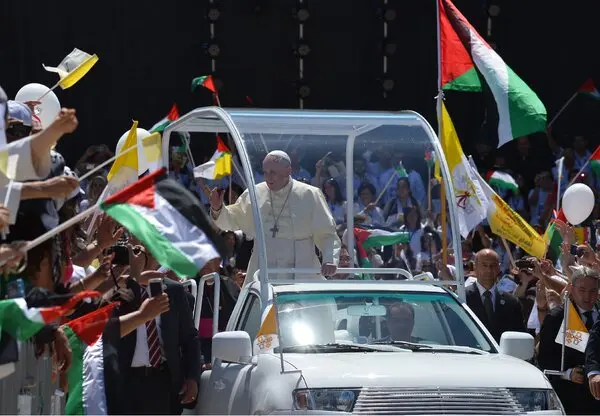
One of Pope Francis’s popemobiles is being transformed into a mobile health clinic for children in the Gaza Strip, fulfilling one of his final wishes, the Vatican's official media outlet said on Sunday.
The vehicle, used by the late pontiff during his 2014 visit to the Holy Land, is being outfitted with diagnostic and emergency medical equipment to help young patients in the Palestinian enclave, where health services have been devastated by the Israeli invasion.
Pope Francis, who died last month, entrusted the initiative to the Catholic aid organisation Caritas Jerusalem in the months before his death, Vatican News said. Peter Brune, Secretary General of Caritas Sweden, which is supporting the project, told Vatican News
"This is a concrete, life-saving intervention at a time when the health system in Gaza has almost completely collapsed. It's not just a vehicle. It's a message that the world has not forgotten about the children in Gaza."
The mobile unit will be equipped with rapid infection tests, vaccines, diagnostic tools, and suture kits, and staffed by medical personnel. Caritas plans to deploy the clinic to communities without access to functioning healthcare facilities once humanitarian access to Gaza is feasible.
Gaza has a tiny Christian community and Pope Francis phoned that little bombarded Catholic church almost every day, even during his illness. How very sad that this much needed lifesaving gesture will have to wait until humanitarian and medical supplies can get to where it is needed most.
Join a conversation on the issue of non-violence with Palestinian activist and academic Mahmoud Zwahre and Andrew Rigby, Emeritus Professor of Peace Studies
We Choose Non-violence - conversations with Palestinian activists
Illustrated with film by West Bank filmmakersIncludes updates from the West Bank and the significance of ‘Sumud’ in the Palestinian struggle.
Mahmoud Zwahre is a leading activist and organiser in popular non-violent resistance against settler violence in the West Bank and currently a scholar at Coventry University
Andrew Rigby has researched and written about unarmed resistance in the Occupied Palestinian Territories since the 1980s, activities informed by his deep commitment to nonviolence as practice and principle.
Doors open & refreshments 2.30pm
In Conversation
This is the first in a series of events which aim to provide a safe space where you can listen, talk, ask questions and find out more.
Host a Supper Club for Palestine this Summer
The Amos Trust are running a promotion for people to hold ‘Summer Palestine Supper Club’ event.
Join them to honour Palestinian culture by bringing friends, family, or your local community together for a meal as an act of cultural resistance that supports the Gaza and West Bank appeal. Whether it’s a cosy dinner at home or a bigger gathering at a venue, it’s a simple but powerful way to stand in solidarity with Palestinians.
Ask guests to donate what they would spend on a meal out
Enjoy great food, conversation and solidarity
“Where politics has been the tool for Israel to divide us, culture has been our tool of uniting ourselves... and that’s why it’s really important for the solidarity of our friends to understand that, we are not that self-centric that we want to eat hummus all the time, but it has become a way of resilience and looking inward to ourselves, putting a nice warm jacket on ourselves by keeping participating and celebrating the cultural element of the Palestinians.”
We are gathered here in Leeds City Square to mark Holocaust Memorial Day.
Tomorrow will be the 80th anniversary of the liberation of the Auschwitz-Birkenau death camp in Poland in 1945.
It’s estimated that more than a million people perished in Auschwitz during the Second World War. The vast majority were Jews. But there were also Roma and Sinti and Gays, all murdered just for who they were.
In all, it’s estimated that six million Jews were killed by the Nazis during the Holocaust including around 1.5 million children.
The Nazi Holocaust destroyed a third of the global Jewish population, with centuries of culture and heritage lost forever.
And the world said: NEVER AGAIN. But genocide did happen again.
Which is why, on Holocaust Memorial Day, we are also encouraged to remember the victims of genocides in Cambodia, Rwanda, Bosnia, and Darfur.
None of these subsequent genocides detract from, or diminish, the magnitude of the Nazi Holocaust. And nor should they. The point of highlighting other genocides is not to draw equivalence with the Nazi Holocaust. Every genocide has been unique in its form, scale and execution. But they all share some common traits including collective discrimination, dehumanisation and the intent to exterminate (in whole or in part) a distinct people.
The Holocaust Memorial Day Trust encourages us to learn from past genocides so that we can, in its own words “take action for a better future”. A future in which “identity-based persecution and discrimination” comes to an end.
The Holocaust Memorial Day Trust takes its lead from the UK government in determining if a genocide has taken place. But what happens if our own government is itself implicated in a genocide? How do we then act for a better future?
We cannot always wait until courts and governments have reached a unanimous agreement on whether a genocidal atrocity is taking place. Too often, that only happens long after the horrors have ended and when there is nothing left to be done. And, as has become abundantly clear in these last 15 months, reaching such a consensus is a political decision as much as a legal or moral one.
This year the official organisers of Holocaust Memorial Day events, the HMD Trust, has shown its reluctance to acknowledge even the potential that a genocide has been taking place in Gaza. A genocide perpetrated by the State of Israel against the Palestinian people, but with the finance, weapons and diplomatic cover coming from
the United States, and with support from America’s Western European allies, including the United Kingdom.
The Trust has asked event organisers around the country, as well as teachers in schools, not to refer to what has been happening in Gaza since the 7th of October 2023. That includes the Hamas atrocities in Southern Israel which left nearly 1,000 Israeli civilians brutally murdered and 250 men, women and children kidnapped into Gaza.
I know some will want to frame the Hamas attack as anti-colonial resistance. Just as some will say that Israel was simply acting in self-defence when it launched its attacks on Gaza.
But if you are serious about the value of international law and a rules-based global order, then neither ‘anti-colonial resistance’ nor ‘self-defence’ can be used to justify mass atrocities.
At least 47,000 people, mostly civilians, including 18,000 children, have been killed by Israel using American-made and paid-for weapons. Independent health and humanitarian experts put the number of dead much higher than Hamas itself has done.
100s of thousands of Palestinians have been injured. Many of those injuries will be life-changing.
Homes, schools, universities, mosques and churches have been destroyed. Civil infrastructure, including access to water and healthcare, has been deliberately demolished. Agricultural land has been ruined. An already weak economy has been wrecked.
There has been mass hunger and the risk of mass starvation caused by Israeli political decisions.
Millions have been displaced. And in this fragile ceasefire, they find they have no home to return to, only rubble and the buried remains of children, mothers, fathers, and grandparents.
But the Holocaust Memorial Day Trust fears that talking about Gaza will politicise commemorations and detract from Holocaust remembrance.
We are gathered here today because we profoundly disagree with that thinking.
When the International Court of Justice has recognised that accusations of genocide against Israel are legitimate and must be investigated…
…when the judges at the International Criminal Court have issued warrants for the arrest of the Prime Minister of Israel…and Hamas leaders…
…when scholars of the Holocaust and genocide, including Jewish Israeli academics, have called Gaza a genocide…
…when Genocide Watch, a global organisation recognised as experts in genocide, has called Gaza a genocide…
…then refusing even to acknowledge that a potential genocide has happened, undermines the work and the moral authority of the Holocaust Memorial Day Trust.
The Trust’s refusal to mark what has happened in Gaza is itself a deeply political act.
To place Gaza off limits when it comes to who we are allowed to grieve in the context of genocidal harm, does not honour those murdered in the Holocaust or subsequent genocides.
Nor does such a decision respect international law or its institutions.
Taking such a stand ignores the testimony of Palestinians in Gaza. It ignores the Palestinian journalists who have risked or lost their lives. It ignores the live-streamed images of indiscriminate, mass destruction we have watched on our phones for months on end.
We should not make decisions about genocides based on where our funding comes from. Or which national allies will be implicated or shamed. Nor should we create hierarchies of suffering in which the collective trauma of one group is used to suppress the suffering of another. That’s not how you address antisemitism or build societies that will fight racism and resist the politics that can lead to genocide.
That’s why we feel the need to hold this event today. Because we must say:
NEVER AGAIN FOR ANYONE.
We will spend our time here sharing readings and standing in silent vigil to mark the genocides of the past and the ones which have been taking place today.
We will recall the Nazi Holocaust, Cambodia, Rwanda, Bosnia, Sudan and Gaza. And we must also remember the genocidal acts which have been committed in recent years in China against the Uyghur Muslims, in Myanmar against the Rohingya Muslims, in Syria and Iraq against the Yazidi people, and the war crimes against civilians in Yemen and Eritrea.
Because there can be no hierarchies of remembrance and no exceptions to acknowledging genocides.
Today we grieve for all who have lost their lives through tribalism, nationalism and racism. And we commit ourselves to ending genocide wherever it takes place and whoever is the perpetrator.
NEVER AGAIN MUST MEAN NEVER AGAIN FOR ANYONE, ANYWHERE.
Thank you for being here.
On behalf of the organisers of today’s event, we thank you all for coming and for the respect you have shown for all those lives lost to the horrors of genocide.
We see with heavy hearts how Christians, Muslims, Jews, and people of other faiths and no faith, have been the victims of genocide and, tragically, also the perpetrators of genocide. No people or nation should consider themselves incapable of committing such atrocities.
We also recognise, that ‘starting the clock’ of genocide remembrance with the defeat of Hitler has obscured the atrocities committed by Western European nations through imperialism and colonialism in the earlier 20th century and in the centuries before. Failing to reckon with this past does not help us to build resilience against the politics of dehumanisation today or in the future.
Right now, we must keep our eyes, and our hearts focused on Gaza and on Sudan where genocide has been and still is taking place.
The world’s attention may move on. The political attempts at denial and normalisation (especially regarding Gaza) will no doubt continue. And those who dare to say the word ‘genocide’ about Gaza will go on being ostracised and vilified.
by Rt Hon Sir John Battle (Chair Leeds Diocesan J & P)
(former Minister of State at Foreign Office)
A ceasefire pause and the release of some Israeli captives and Palestinians prisoners is a welcome relief 15 months after a violent act of Hamas terror and an Israeli war of reprisal in Gaza. Too many have died and suffered as this war has been played out. While internationally political leaders express relief that inflamed tensions in the Middle East and subsequently worldwide have not escalated to a much wider war, a real peaceful project remains on the distant horizon.
The personal hostage and prisoner release exchange has a long way yet to go for future months. There is again a temporary ceasefire in military action. At last, more humanitarian aid trucks are allowed into the stressed communities of Gaza. But issues of where homeless Palestinians return to and who rebuilds and rules Gaza remain.
This present agreement is a pause; a stepping stone out of the violent conflict. The way forward in the direction of a settlement for both Israeli and Palestinian communities remains a utopian chimera. Some Israeli politicians still want the war to be continued. Hamas fighters out celebrating with raised guns seems far from a peaceful settlement.
Those not involved directly in some way in this fragile initiative and who have been reduced to passive TV bystanders and observers cannot now turn away in vaguely hopeful relief. There can be “no peace without justice” as Catholic social learning has long insisted.
“The problematic roots of an initially flawed structural settlement remain. The peace process cannot be left to current politicians and military leaders to carry through. Seeking justice and peace in the context of Israeli and Palestinian peoples requires we all take responsibility to respond whatever our own circumstances in prayer, thought and action in particular to the development of a longer term vision and practice of a reconciled future, working for a peace built on firm foundations of justice.
To provide the best experiences, we use technologies like cookies to store and/or access device information. Consenting to these technologies will allow us to process data such as browsing behaviour or unique IDs on this site. Not consenting or withdrawing consent, may adversely affect certain features and functions.
Functional Always active
The technical storage or access is strictly necessary for the legitimate purpose of enabling the use of a specific service explicitly requested by the subscriber or user, or for the sole purpose of carrying out the transmission of a communication over an electronic communications network.
Preferences
The technical storage or access is necessary for the legitimate purpose of storing preferences that are not requested by the subscriber or user.
Statistics
The technical storage or access that is used exclusively for statistical purposes.The technical storage or access that is used exclusively for anonymous statistical purposes. Without a subpoena, voluntary compliance on the part of your Internet Service Provider, or additional records from a third party, information stored or retrieved for this purpose alone cannot usually be used to identify you.
Marketing
The technical storage or access is required to create user profiles to send advertising, or to track the user on a website or across several websites for similar marketing purposes.


 Showing solidarity with Palestinians through supporting this film festival is a very small action that we can take, but it is something that has been repeatedly mentioned by Palestinian visitors in recent years. It shows both that we care and that we want to understand the reality of the situation beyond the propaganda messages put out by Hamas and the Israeli defence Forces.
 The film this year has been chosen by the Leeds Diocese Pax Christi group in consultation with the Film Festival committee. It is called “There is Another Way”. The film follows the members of Combatants for Peace. This organisation, nominated for two Nobel Peace Prizes, is an extraordinary bi-national group of former enemy combatants - Israelis and Palestinians - working together during an ongoing armed conflict. Confronted with the devastation and escalating violence of October 7th and the war in Gaza, the very core of the movement faces great challenges in showing that there is another way. The first question they must move past relates to their own beliefs...is this possible?
 SPARK is making this happen with financial support from the Sisters of Our Lady of Sion
 There will be a Memorial for the Children of Gaza on Saturday August 23rd in Leeds City Centre (on Briggate - near to the entrance to Marks & Spencer's) from 9.00 am to 6.00 pm organised by an informal group of activists.
 When I set out in January, there were hopes of a ceasefire in Gaza – now one has come and gone. MAP’s comment on the present dire situation:
 My original goal was 10 miles a day, but I have upped it to 12 so I can finish on my 77th
 Each chapter begins with the historical context in Gaza, even going back to the Ottoman empire years. This useful background allows the food insecurity and malnutrition over the last 100 years to be recorded and explored.
 What is clear is that recovery work in the Gaza strip will take decades. Whilst aiming to be factual, it is clear that Windle is on the side of justice for the Palestinian people. His is a thoughtful analysis but it doesn’t try to hide the fact that mostly Israeli governments have had no real commitment to justice for Palestinians or a Palestinian state.
 Join a conversation on the issue of non-violence with Palestinian activist and academic Mahmoud Zwahre and Andrew Rigby, Emeritus Professor of Peace Studies
 Host a Supper Club for Palestine this Summer


 This present agreement is a pause; a stepping stone out of the violent conflict. The way forward in the direction of a settlement for both Israeli and Palestinian communities remains a utopian chimera. Some Israeli politicians still want the war to be continued. Hamas fighters out celebrating with raised guns seems far from a peaceful settlement.
