The global debt crisis: the example of South Sudan
Join CAFOD online at 1pm on 26 May to hear how low-income countries like South Sudan are struggling with huge debt burdens.
Hear from:
Kumi Anthony, Programme Manager, South Sudan
Maria Finnerty, CAFOD’s Lead Economist
Helen Moseley, Campaign Coordination Manager, who will share how we can all help push for change.
Low-income countries are struggling with huge debt burdens. Hear from South Sudan speakers on how their country is coping, Maria Finnerty, CAFOD’s Lead Economist, on some practical solutions, and CAFOD’s campaigns team on how we can all help push for change.
Call for debt justice with CAFOD, in solidarity with millions of our sisters and brothers around the world
Last year, our Catholic community supported a global church campaign to tackle the debt crisis, but we need continued support, to change the devastating impacts of debt on low-income countries. During the Jubilee Year, 35,000 people signed CAFOD’s petition including 18 parishes across the diocese of Leeds, including a group of parishioners who joined others in London to speak to their MP’s face to face about this issue, let us now build on this hope. Please see cafod.org.uk/cancelthedebt
All countries borrow money. But low-income countries need to borrow more and are pushed into deepening debt crisis, paying high interest rates to wealthy lenders. Often, they have paid their original debt back, but spiralling interest means they cannot break the cycle. Money that should be spent on food, healthcare, and education is flowing out of countries that can least afford it. Governments across the global south must choose between serving their people or paying creditors.
Wesley Chibamba, Caritas Africa’s Policy and Advocacy Officer, explained people are dying because they can’t access healthcare. Children cannot go to school. People are going hungry because the governments have debt obligations. Governments don’t have the capacity to respond to humanitarian crisis, like floods or drought – they don’t have the funds.
Archbishop Gabriele GiordanoCaccia, says
“The current debt crisis represents a profound failure of our global economic system…If a mother cannot access prenatal care because the government has cut healthcare spending to service debt… if communities cannot rebuild after disasters because the resources are diverted to foreign creditors, we must acknowledge that there has not just been a serious economic failure but a moral one.”
Next year, our government is hosting the G20 in 2027 - a crucial gathering of the world’s 20 most powerful economies. These leaders have power to fix the global debt system; we need to call for debt justice now.
With the global debt crisis high on the agenda at this week’s G20 summit, actor Alex Macqueen is starring in a spoof television advert released in the UK today (19 November 2025). Created by Richard Curtis’ Project Everyone initiative in partnership with Catholic aid agency CAFOD, the satirical commercial Meet the World’s Loan Sharks exposes the global debt crisis as tantamount to pay-day loans.
Best known for his roles in The Thick of It, Hijack, Rivals and Inbetweeners, Alex attended a special screening of the 90 second spoof on 19 November, for MPs at the Houses of Parliament, and it is also being released across the social media channels of NGOs and influencers.
Aid agency CAFOD is calling for the UK government to step in at this weekend’s G20 Summit on 22-23 November in South Africa, to encourage members to support a new system for managing unsustainable debt for lower income countries. The most important aspect of a new system, is that all debt repayments for low-income countries be put on pause as soon as they apply for debt relief. Without this, private lenders have zero incentive to cooperate, as they continue to receive payments.
CAFOD is also calling on the UK government to pass a new Debt Justice Law to force private lenders to take part in debt cancellation. UK law governs 90% of countries covered by the G20 debt relief scheme and 50% of all international debt.
In the film CAFOD Ambassador, Alex Macqueen, plays the part of a fictional and predatory ‘dodgy lender’ - representing the private banks and hedge funds that are allowed to target vulnerable low-income countries with loans, at exorbitant interest rates. Styled as a daytime television advert for a pay-day loan company, he’s wearing an ill-fitting suit and offers outrageous deals, all with dodgy graphics and sinister undertones.
His character in the film says:
“Are you a small country struggling with money? Finances been hit hard, through no fault of your own, by climate change, natural disaster, war? Can’t find the cash to pay for the basics? Like roads, electricity and water? Have no other access to credit?
“We're here to help. We give cash to countries just like you, every day. We’ve lent to dozens of nations. All at incredible interest rates. Worried you won’t be able to pay it back? That even though you’re careful with money you’ll be stuck in a cycle of poverty? A never ending spiral of debt? Not a problem - simply cut back your spending on other areas like hospitals and schools.
“And if you can’t pay it back, don’t worry, we’re happy to lend you more.”
The spoof finishes with a voiceover, stating:
“Find out more at unfairloans.com - terms and conditions apply - unless of course you're from a high income country, obviously that’s totally different. Oh and we’re barely regulated - governments allow us to operate this way - so there’s no comeback. And in fact if you don't repay, we'll sue you.”
Alex Macqueen says:
“The comparison to pay-day loan sharks perfectly captures the shockingly unethical and exploitative nature of the debt crisis. Those at the sharp end of poverty are forced into debt with scandalous interest rates just to survive, but the more comfortable can access reasonable loan arrangements. Clearly something has gone very wrong.
“With nearly half the world’s population living in countries that spend more on interest repayments than they do on essential services like schools and hospitals, it’s ordinary people who are most deeply impacted by this terrible unfairness. With the G20 imminent, now is the time to bring attention to a too long ignored outrage.”
Maria Finnerty, Lead Economist at CAFOD says:
“The UK outlawed exploitative loan sharks years ago, in a hugely popular move with support across the political spectrum. If predatory lending is illegal in the UK we must not allow it to continue globally. It’s time to apply the same logic and compassion to countries where millions suffer the consequences of unethical lending, decimating spending on health and education and condemning hundreds of millions of people to poverty.
“The UK is a global debt superpower, with 90% of private loans to low-income countries governed by English law. The government could change the law tomorrow at zero cost to UK taxpayers, solving 90% of the problem and benefiting millions of people overnight. All that's missing is the political will.”
In the last 10 years the number of low-income countries facing unsustainable debt levels has more than doubled, from 22 in 2015 to 54. Across Africa debt has skyrocketed from $17 billion in 2010 to $74 billion in 2024, a 335% increase in just over a decade, with 34 African countries now spending more on external debt payments than on health or education.
Private lenders charge low-income countries interest rates of 6-10%, but wealthy nations 0-1% meaning that low-income countries are often required to repay their original debts several times over. For instance, average borrowing costs for countries in Africa are 9.8%, compared to 0.8% for developed countries like Germany.
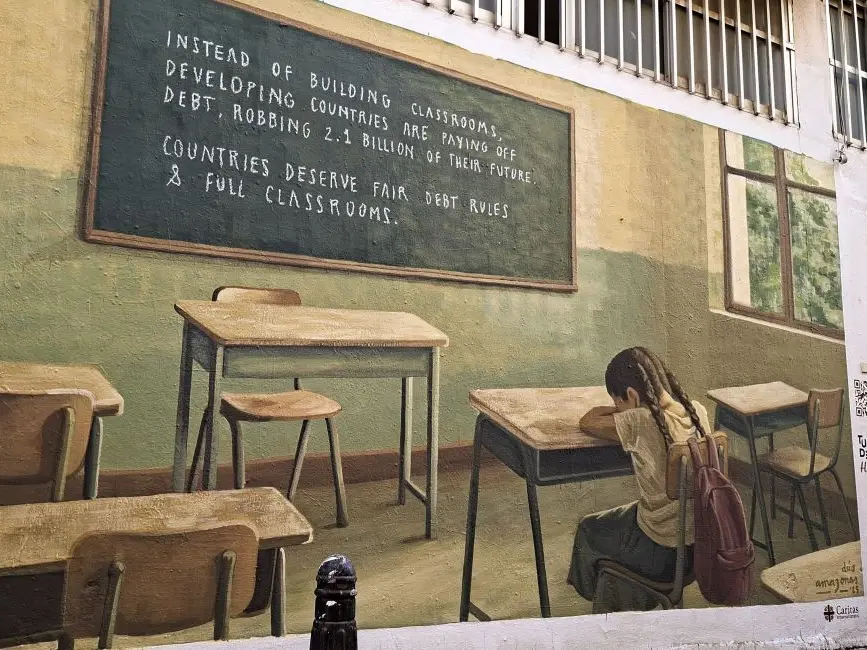
The impact on ordinary people is devastating. This is money that should be feeding children, training nurses, building schools and preparing for floods. Families feel this every day — when clinics run out of medicine, when classrooms are overcrowded, and when governments can’t hire the teachers and doctors that people need.
Hannah Cameron, Campaign Director at Project Everyone, says:
“We wanted to find a simple way to tell the story of the global debt crisis and its human impact. With the help of Alex Macqueen’s dodgy loan shark character we did just that. I hope it leads to increased understanding and public support for new solutions.”
This year’s G20 in Johannesburg offers a once-in-a-generation opportunity to fix a broken system. For the first time in years, sovereign debt is on the G20 agenda and with 2025 marking a Jubilee Year, global movements are renewing their call for large-scale debt relief.
Anyone wanting to learn and do more can visit unfairloans.com.
As we mourn Pope Francis and pray for the new Holy Father, and the Cardinals, who will be gathering to elect a new Pope, we continue to celebrate the Jubilee Year Pilgrims of Hope. We recall that, in his letter for the Jubilee Spes non confundit, Pope Francis invited us all to be
“tangible signs of hope for those of our brothers and sisters who experience hardships of any kind.”
His model was the biblical Jubilee of the book of Leviticus. Taking place every fifty years, the Jubilee marked a great societal reset - land returned to its original owners, debts were cancelled, relationships restored, and creation renewed (see Leviticus 25).
We celebrate this Jubilee Year in a world where injustice, conflict and abuse of creation are sadly still prevalent. Just as the biblical Jubilee sought to transform economic and community life to reflect the values of God’s Kingdom, so we too are called to advocate for change today.
Central to this is the call for debt justice. In this Jubilee Year of Hope, Pope Francis called for richer countries to cancel the debts of poorer nations who are struggling with immense debt burdens, saying:
“More than a question of generosity, this is a matter of justice.”
CAFOD is part of a worldwide Caritas campaign this year calling for action on the global debt crisis. There is a petition that is being signed in 160 countries, calling on world leaders to take urgent steps in this Jubilee Year. You can sign the petition at cafod.org.uk/debtpetition and also invite others in your parish to sign by ordering paper copies at cafod.org.uk/cancelthedebt
As part of CAFOD’s parish materials there is a letter from Father Charlie Chilufya, a priest based in Kenya, to parishioners in England and Wales. In the letter Father Charlie explains the impact that the debt crisis is having on the Kenyan people, since Kenya is spending five times on repaying foreign debts as it spends on hospitals and schools.
“Families are foregoing medical care and children are losing access to quality education.”
Pope Francis spoke about the debt crisis and the need for action in the Jubilee Year many times in the last year of his life. Join parishes, schools and the whole Catholic community to respond to his call, at cafod.org.uk/cancelthedebt.
Finally, during May we will celebrate Volunteers week, and we give so much thanks to all volunteers in the Church. You all make such a difference, and we couldn’t do what we do with you.
Manage Consent
To provide the best experiences, we use technologies like cookies to store and/or access device information. Consenting to these technologies will allow us to process data such as browsing behaviour or unique IDs on this site. Not consenting or withdrawing consent, may adversely affect certain features and functions.
Functional
Always active
The technical storage or access is strictly necessary for the legitimate purpose of enabling the use of a specific service explicitly requested by the subscriber or user, or for the sole purpose of carrying out the transmission of a communication over an electronic communications network.
Preferences
The technical storage or access is necessary for the legitimate purpose of storing preferences that are not requested by the subscriber or user.
Statistics
The technical storage or access that is used exclusively for statistical purposes.The technical storage or access that is used exclusively for anonymous statistical purposes. Without a subpoena, voluntary compliance on the part of your Internet Service Provider, or additional records from a third party, information stored or retrieved for this purpose alone cannot usually be used to identify you.
Marketing
The technical storage or access is required to create user profiles to send advertising, or to track the user on a website or across several websites for similar marketing purposes.




 Maria Finnerty, Lead Economist at CAFOD says:

