The Financial Times ended the year with a major two page spread "The Ascension of the Catholic Right". The new year copy of "Private Eye" included a Jonesy cartoon of Jesus delivering the sermon on the mount; citing "Blessed are the meek", "Do not store up for yourselves treasures on earth", "Love your enemies" "Blessed are the peacemakers". A man at the back of the crowd in a Maga hat turns and asks: "What the hell kind of Christian is this guy anyway?"
Interpreting Jesus and his Gospel has fractured the Christian traditions from the origins, leading to divisions, conflicts, splits and wars, not least in the United Kingdom's history. The violent divisions of the Reformation and the Puritan migration to America in the seventeenth century sparked off conflicts there that are evident today. As 1960's singer Joan Baez stressed: each claiming "God on their side".
Christianity has long featured in polarising American society and, increasingly, its current politics. In a now more extremely and crudely binary America, Christianity is a crucial determinant and one from which Catholics are not exempt.
Catholics represent a fifth of all Americans and constitute the largest single voting block. Brian Burch, the American Ambassador to the Holy See is a personal friend of President Trump and his "Catholic Vote" organisation to help return him to the White house. 59% of American Catholics backed Trump not least as a result of geodata collected from churchgoers phones by "Catholic Vote".
Prominent Catholics are entrenched in President Trump's administration (a third of his Cabinet), including Vice President JD Vance, Secretary of State Mario Rubio and Defence ("War") Secretary Pete Hesketh and Sean Duffy (Secretary of State for Transportation).
They are not shy to claim to apply precepts of the Catholic faith as they see them to the politics of governing America today. Nor can they be crudely dismissed with the "Christian nationalists" label - who effectively want to convert Americans at the point of a sword. There are Christian nationalist currents in the Maga movement. "Dominionism" is popular among Trump supporters - particularly in the form of the National Apostolic Reformation movement which aims to "reclaim society for God and America", leading to a "Gilead" version of conversion.
There are also the right wing institutes, think tanks such as the Heritage Foundation led by influential Catholic political strategist Kevin Roberts. Tech billionaires such as Catholic Peter Thiel of Pay Pal and Palantir is a future "survivalist" who wanted to build a "post apocalyptic" bunker in New Zealand and proposed "seasteading" - building artificial islands for survivors beyond government controls. He claimed in the FT that Trump's second term heralds "a good apocalypse" that will "adjudicate the sins of those who govern us today". More recently shock jock media hosts and influences such as Tucker Carlson and Nick Fuentes no longer speak of "Judeo-Christian” values. They dispense with the "Judeo" and insist on espousing an aggressive Christian nationalism.
But while Evangelical and the Puritan voice is loud in the Republican tradition there are also prominent and serious Catholic conservative intellectuals. Patrick J Deneen, Professor of Political Science at Notre Dame, has, since his book " Why Liberalism Failed" published in 2018, emerged as the leading Catholic conservative intellectual, describing himself as "a Common Good conservative" rooted in Catholic social teaching. He pinpoints the liberal democratic focus on "borderlessness" as the core liberal virus breaking the interests of American workers (and voters) under a banner of neo-liberal economic globalisation. His focus is on family and local community, anti consumerist, anti monopoly and protectionist., and critical of so called "woke" ideas of race and identity politics.
Closer to home, James Orr, Associate Professor of Philosophy of Religion at Cambridge University has been described by Vice President JD Vance as his "British Sherpa". Professor Orr was appointed a senior advisor to Nigel Farage in October 2025. He chairs the Edmund Burke Foundation and holds strong right wing views aiming to "strengthen natural conservative principles". He has referred to asylum seekers as "invaders" and is a member of the Free Speech Union.
In other words, as Rowan William notes in the New Year edition of the New Statesman (12 dec/ 8 Jan) US style "Christian nationalism" is slowing infiltrating the far right here through insistence on "Christian identity” as a condition of citizenship.
The idea that society should be governed by explicitly Christian principles — with government recognising the Lordship of Jesus Christ and basing law on the Ten Commandments with penalties for non-compliance — shows how once unthinkable proposals become normal.
Topics once considered fringe are now pushing mainstream politics toward fundamental questions of national identity and social cohesion. They require theo-political and prophetic deep reflection and considered compassionate and practical responses in detail.
The colours of the sunrise I can see changing as the sun rises.
That I live in a democracy that gives me a voice, and provides welfare, health services, education, guidance, security, transport and regulates water, power and communication services. It’s not perfect but it continues to evolve without us taking to the streets in violent protest. And works to reduce the harms of Big Tech whose media platforms share so much unhealthy, hate filled and incorrect content with their subscribers.
The thousands of public servants who are the frontline service providers of Government. Their ability to provide the services they used to has reduced over time and they can be treated badly by those who are angry and feel let down.
The thousands of workers in the Charity sector, paid and unpaid, who also provide services to us. And face similar abuse at times. Especially those who fill in the gaps between different services and provide holistic service.
The freedom to practice my faith without fear.
The steps being taken to reduce violence against women and girls. I hope that the Christian Churches will, through their schools and worship, take a positive lead in this and teach their children to respect themselves, developing healthy emotional, spiritual and physical beliefs. And to respect others and treat them kindly in friendships and partnerships that are based on sharing an equality of power that does not exploit. Thus empowering adults to form long lasting relationships that provide any children they have with a secure childhood and the ongoing nurture of both parents and wider families well into their adulthood.
That our legal systems and police are independent and will challenge politicians and others who overstep legal boundaries.
That since pre historic times this land has been settled by travellers from across the seas that surround us. They have given us place names, a language and many cultural traditions, including that of tolerance, as well as different religions. And that most of us still welcome those who come here to work, study or find refuge.
especially the phrase ‘forgive us our sins as we forgive those who trespass against us.’ I realised this when I was listening to news reports from Gaza, Ukraine and the Sudan where there is little sign of reconciliation or dialogue with the aim of healing past hurts.
This is an every day reminder that we can, and should, forgive others and move forward in order to live as well as God intends. This can be hard though.
The phrase ‘lead us not into temptation’ is so relevant for an internet enabled world of 24/7 temptation. Unsubscribing to feeds that show content we’re not comfortable and or emails that bombard us with ‘special offers’ reduces the temptation we face. I now spend more time and money mindfully, so I consume less - Live Simply.
The Hail Mary,
especially ‘pray for us sinners’ which reassures me that I’m not meant to be perfect but I am worthy of prayer and support.
The Penitential Rite,
especially the phrase ‘I have sinned through my own fault, in my thoughts and in my words, in what I have done, and in what I have failed to do’. This reminds me that my choices have consequences.
If I accept that I did make a choice I may make a better choice next time. I can learn and live better. I know that sometimes other factors influence the outcome but that’s awareness helps me to learn too.
The Beatitudes
As a teenager I spent many hours discussing what each statement meant to discern how to live well as an adult. I particularly remember ‘Blessed are the poor in spirit’ provoking debate about career choices, job content being more important that pay. And how we spent what money we had, the difference between what we needed and what we wanted, and reducing jealousy when others had ‘more’.
Another clear memory relates to ‘Blessed are the peacemakers’ when we talked about relationships, for example ‘was it better to keep quiet if someone in your friendship group really irritated you’ or should you exclude them. Firm conclusions were difficult. But with practice I got better at telling people about how I felt about what had happened and learnt how develop maturing relationships.
I have little influence over politics and the big choices made on my behalf but these prayers and Gospel reflections enable me to make conscious choices that have a positive influence on the quality of my relationship with God and others. I feel blessed that my faith gives me these regular practical reminders that help me live a better life.
This book is a pastoral reflection. It quarries the wisdom of others. It asks: how best can we be equipped to bring the love of God to a fragile and threatened world, to empower all the baptised to become the missionary, synodal church of the first Christians and Popes Francis and Leo? Aren’t we doing that already? Yes and no.
It argues that a contemplative vision lies at the heart of Jesus. All Christians equally by virtue of their baptism are invited to imitate that love of the ‘Sacred Heart’. To cultivate a ‘loving personal relationship with Jesus’.
Yes – but how? We are to use prayer – personal, the Church’s prayers, the rosary, worship, the Eucharist, adoration, lectio divina, meditation.
Is anything missing? The book turns to the wisdom of the Church’s largely forgotten contemplative tradition and to the voices which are increasingly arguing for its restoration.
"By consciously reinstating, repositioning the contemplative vision, mind and practice (‘heartsight’) at the centre of the Church’s ‘mindsight’ (theology, teaching, beliefs), in its worship, life in parish and communities and crucially as the bedrock of its mission to the world, all these will be enabled to circle round, as planets round a sun, the gravitational pull of the love of God."
But what exactly does all that mean? The book tries to explain how by the steady practice of ‘letting go and letting God’, of silent ‘contemplative’ prayer, of letting God speak; in not talking or praying or thinking at all - we slowly adapt the contemplative spirit and mind. In that spirit Jesus bids us not only to love our neighbours but also our ‘enemies’. The Heart guides the Head. It was and is the Way of Jesus we are invited to follow.
The book turns for aid in this to the Church’s mystics and the contemplative tradition stretching back to Jesus to Paul, past the Desert fathers and Mothers to the monasteries, to the Cloud of Unknowing, Julian of Norwich, St Benedict, St Francis, St Therese of Lisieux and a whole chorus of others. Contemplative practice has broken out of the monasteries and religious houses. It has always existed unacknowledged in our pews. The book describes the growing number of organisations opening the contemplative door in ways to ‘realise the Sacred’ and thereby to anchor worship, parish life and mission securely in the search for union with God.
Lastly the book argues that this spirit lies behind the ‘conversations in the Spirit’ which underpins the synodal process. In the spirit of contemplation we listen, we are silent and only then do we speak –out of minds guided and unfused by that ‘heartsight’ which is Christ’s.
Read the book for the full explanation of this crucial theme. The author prays that in this way the ‘Sacred’ may truly be ‘realised’ - as the very definition of the Church we love, in its mission to the world we love in Christ.
For anyone watching or reading the news, we are in one of the most worrying times since the end of the Cold War. Awful and destructive conflict in Gaza and the West Bank, along with regular attacks across the Middle East in the likes of Iran, Syria, Lebanon and Yemen. Then there is the ongoing nightmare of the Russian invasion of Ukraine with day after day of deadly drone attacks and grinding battles on a front across southern Ukraine.
And there are many conflicts elsewhere that rarely make the headlines in the likes of Myanmar, Sudan, Ethiopia and terrorist insurgencies across many countries, such as Christians regularly being killed in Nigeria by followers of the group Boko Haram, inevitably creating then revenge attacks.
At the same time, the threat of major conflict outside Ukraine has seen all NATO members, under significant American pressure, start raising their defence budgets markedly, most pledging that 5% of national GDP will go on defence expenditure. In the UK this sees billions planned for our Trident nuclear weapons programme, on developing other weapons of mass destruction such as drones, new warplanes and cyber warfare.
As a keen reader of history, I find this current period one of the most turbulent and scary, particularly as the ‘rules based order’ of diplomacy has been dumped by the likes of President Trump and President Putin.
On the other side of this, actively demonstrating opposition to such actions has become more difficult. The previous government brought in legislation making peaceful demonstration much more challenging – in an unnecessary kneejerk response to the likes of Extinction Rebellion and Just Stop Oil – and the current government have followed up in their recent ban of the group Palestine Action, prescribing them in the same manner as a terrorist group.
So, what should be our response as Christians to all of this pain and misery? An obvious response by many people is to try and ignore it in a feeling of hopelessness and powerlessness. It is immensely hard to watch the daily news and see all this thoughtless death and destruction.
But we need to ponder daily what Jesus would do, and I think he would want us always to stand up and be counted. But what to do?
I have some Catholic Christian friends who have got heavily involved in some non-violent direct action, some being arrested for supporting Palestine Action, or doing some more militant action as part of the campaign to tackle climate change. If your conscience allows that, and you can deal with any of the consequences that comes from that, then stand up for what you believe in.
Certainly, go on one of the regular demonstrations supporting the Palestinians, and do get involved in the climate change movement in many different ways, big and small. And join groups like Pax Christi, Sabeel International or the many local groups supporting Ukrainians living in the region.
Taking effective action reduces the feeling of hopelessness and powerlessness and you are actively standing up for peace and justice. But do be careful with yourself, take care with your mental health as these issues can really overwhelm you.
Just as important can be to write to your MP telling them that doing nothing is no option. Call them to stand up and be counted. Recent rebellions over welfare policy came about as MPs knew the high levels of public discontent, so it is a much more valuable tool than sometimes we think it is. And continue to get involved supporting foodbanks, assisting refugee and asylum seekers groups with practical aid and financial support.
Never be afraid to speak out either, it is again what Jesus would do. But do be aware not everyone is as clued in to these issues as other, and try and educate them with wisdom and kindness, even when that can feel very hard to do.
And above all, keep these people in your hearts, minds and prayers.
As Jesus says to the disciples:
“Ask and it will be given to you; seek and you will find, knock, and it will be opened to you. For everyone who asks receives, and the one who seeks finds, and to the one who knocks it will be opened.” (Luke 11:10 – 11).
As this lovely prayer from St Jane Frances de Chantal says:
“Every person is a child of God, who loves them infinitely: it is, therefore, impossible to want to love God, without loving human beings – the more one loves God, the more one loves people. The love of God, the love of people, is my whole life; it will be my whole life, I hope.”
That is the hope I hold on to in these challenging and hard times. Jesus insisted on saying blessed is the peacemaker, as we are true sons and daughters of God.
By loving our neighbour, challenging them where we need to, and standing up for those that ask for our help, we can make a difference, and do what our faith tells us to do.
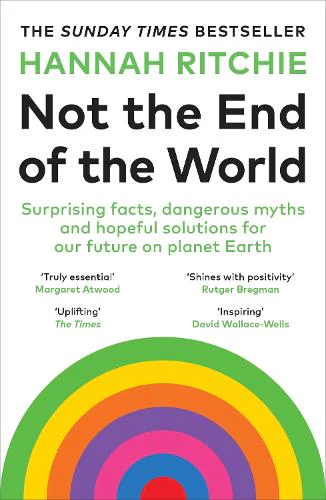
If your young ones are worried about Climate Change and you want to be able to reassure them then ‘Not The End of The World’ by Hannah Ritchie is a good read.
Remember how we succeeded in closing the ozone layer?
Talks about the importance of political will to make things happen and contains some surprising facts about the impact of our individual decisions.
We are bombarded by doomsday headlines that tell us the soil won't be able to support crops, fish will vanish from our oceans, that we should reconsider having children.
But in this bold, radically hopeful book, data scientist Hannah Ritchie argues that if we zoom out, a very different picture emerges. The data shows we've made so much progress on these problems, and so fast, that we could be on track to achieve true sustainability for the first time in history.
Packed with the latest research, practical guidance and enlightening graphics, this book will make you rethink almost everything you've been told about the environment, from the virtues of eating locally and living in the countryside, to the evils of overpopulation, plastic straws and palm oil. It will give you the tools to understand what works, what doesn't and what we urgently need to focus on so we can leave a sustainable planet for future generations.
These problems are big. But they are solvable. We are not doomed. We can build a better future for everyone. Let's turn that opportunity into reality.
‘Fluke’ by Brian Klaas
In ‘Fluke’ by Brian Klaas you get an explanation of why so many forecasts, predictions and polls don’t get it right. (The world is too complex.)
And that is why we should look behind the headlines and question data presented in a way that drives an emotional response (populism) to make better decisions and live better lives.
It’s not as dry as it sounds!
Fluke: Chance, Chaos, and Why Everything We Do Matters: In Fluke, myth-shattering social scientist Brian Klaas deep-dives into the phenomenon of randomness, unpicking our neat and tidy storybook version of events to reveal a reality far wilder and more fascinating than we have dared to consider.
The bewildering truth is that but for a few incidental changes, our lives - and our societies - would be radically different. Offering an entirely new perspective, Fluke explores how our world really works, driven by strange interactions and random events.
How much difference does our decision to hit the snooze button make?
Did one couple's vacation really change the course of the twentieth century?
What are the smallest accidents that have tilted the course of history itself?
‘Great Britain? How We get Our Future Back’ by Torsten Bell
‘Great Britain? How We get Our Future Back’ by Torsten Bell is a readable explanation of how decades of under-investment by both UK Government and private organisations has stalled our economy.
A book for someone who is perhaps fed up with the Government.
The Generation Wars and Housing chapters are particularly thought provoking.
An essential blueprint for a better future, from the leading economist & Labour rising star
‘Stellar: brilliant, incredibly pragmatic’ Rory Stewart ‘Refreshingly optimistic’ The Times ‘No one has done more to re-inject sanity into our national policy’ Emily Maitlis
There are few who are better placed to investigate Britain’s plight than Torsten Bell, Labour MP for Swansea West and former Chief Executive of the Resolution Foundation.
In Great Britain? he offers both a clear-eyed diagnosis of the problems facing our country – a uniquely toxic combination of huge inequality and stagnant economic growth – and a bold vision for the alternative. This is a book bursting with ideas and infectious hope.
In his treasure trove of enlightening and original analysis, Torsten Bell argues that our era of chaos and cynicism needs neither utopianism nor nostalgia, but a practical patriotism to raise living standards and create a more equal country. He passionately points us towards a Britain that we can actually build – a future worth fighting for.
‘A roadmap to the new normal’ Observer 'Pretty cool … the think tank work I raved about on The Rest Is Politics has morphed into a book' Alastair Campbell ‘A dose of Torstenomics is the only thing that can give us hope’ Amol Rajan ‘Spiced with wit, masterful, fact-packed’ Polly Toynbee
**A FINANCIAL TIMES AND OBSERVER BEST BOOK OF 2024**
I recently had the privilege as Pro Chancellor of Leeds Trinity University of presiding over the Graduation ceremonies, great occasions of celebrations of academic achievements by students and their families and friends and the university staff. Leeds Trinity University, a highly regarded Catholic teacher training established in the 1960's by the Cross and Passion Sisters, was upgraded to full independent university status in 2012.
It now has a diverse range of courses including vocational in-service training for health and policing services and retains its reputation for pastoral care of students, again gaining the highest ranking among UK universities for this year.
Previously Leeds Trinity has held one of the highest ranking for "student employability" but today that, as in all universities, is under great pressure. Entry level job vacancies in the UK have slumped to their lowest since 2018. Last year there were an average of 100 applications per graduate job. Moreover, new technology hiring has dropped by 25% since 2023.
The traditional business route into accountancy has dropped off by 30% as AI is reported as replacing start up repetitive tasks such as data cleansing, draft writing and administration. HR managers are no longer needing graduate starters. Over supply of higher educational qualifications is said by some to be depressing job market opportunities (30% of the population now have a degree up from 19% in the 1990's) and certainly the much wished for increase in economic growth has not yet taken off.
Nor is the issue just one of rising graduate unemployment. The official UK unemployment rate rose to 4.7% in the three months to May and vacancy rates have fallen for 36 consecutive periods. The net impact is hitting prospects for young workers hardest.
There are currently 923,000 16- 24-year-old "not in education, employment or training” (known as " NEETS"). They make up 14.2% of the unemployed and represent not just unskilled and youngsters with no relevant qualifications but also years of underfunding of employment support services for young people. The long tail legacy of COVID lockdowns and a sharp rise in youth mental health problems are neglected parts of the picture.
However, increasing the challenge emerges "where will the young work in future?". It is not sufficient to complacently concede to the job reducing effects of new technologies. Recent figures demonstrated that more people in West and South Yorkshire were working in the new warehouse and distribution centres along the MI and M62 motorway routes than ever worked in the Yorkshire coalfields at their peak.
But the age of warehousing replacing mining jobs is now moving in robotics are displacing warehouse workers, especially women packers. In other words, labour markets, from traditional manufacturing and production to service sector administration and management are undergoing profound restructuring and transformation and presently squeezing out opportunities for new young workers.
In his still much neglected social encyclical neglected "Caritas in Veritate" Pope Benedict reflected deeply on the economic and political challenges of our times and spelt out what has not become a new buzz word call for a "reset".
"The complexity and gravity of the present economic situation causes us concern, but we must adopt a realistic attitude as we take up with confidence and hope the new responsibilities to which we are called by the prospect of a world in need of profound cultural renewal; a world that needs to rediscover fundamental values on which to build a better future. The current crisis obliges us to replan our journey, to set ourselves new rules, and to discover new forms of commitment, to build on positive experiences and to reject negative ones. The crisis this becomes an opportunity for discernment in which to shape a new vision for the future".
That vision should now include supporting initiatives for the development of an "Economics of Caring and Sharing" seminal to Catholic social and economic thinking. An elderly disabled woman alone in her flat in Japan was offered a personal robot to help her as her companion coping with daily chores. She asked for it to be taken back and for a young person "whose eyes would smile with mine and who could give me a hug". There is a desperate need for interpersonal service in caring for children, the sick and the elderly, perhaps taxing the heavy lifting by robots and AI will lead to the redistributing of wealth generated to care for each other and our planet.
Meanwhile, as the young in our society worryingly become the "new poor", could we encourage them in the words of St Paul in his letter to Timothy
"Let no one disregard you because you are young ...you have in you a spiritual gift which was given to you when the prophets spoke and the body of elders laid their hands on you; do not neglect it"
I had high hopes that my Church through Synodality we would become a Missionary Church by recognising the myriad ways in which many groups are disadvantaged both within the Church and in Society. Particularly the female half of the population.
At church on Sunday, we listened to the story of Martha and Mary. Our priest gave a homily that started extremely well, by describing our need to find regular solitude and quiet to facilitate individual reflection and prayer. As an SVP member who had spent the previous two weeks supporting someone in crisis I felt the homily would have been improved by stating the need to balance prayer and contemplation with practical works of community and charity.
In this case a beneficiary had been attacked and moved to a place of safety outside Leeds when discharged from hospital. However, they had only the police tracksuit they were wearing on discharge (their clothes being taken as evidence) with them .
They had no cash as it had been stolen. Their essential monthly costs exceed their benefits (bedroom tax and frozen housing benefit being the main reason). Thus they were left in a strange place with no food, clothes, toiletries, or fares back to Leeds for hospital visits. Providing the necessary help on an ongoing basis took its toll.
I often feel that most of the voluntary work done to keep the parish going and via charities like SVP, is done by women. And that an exclusively male Church hierarchy largely focussed on Worship don’t notice. It is women of Faith who do most of the outreach work. Recent Appeals for male vocations made no mention of our need for this type of work in Jesus's name.
Then a talk by 40 Days for Life at the end of Mass irritated me. An over coffee discussion showed I wasn’t alone.
The talk was given by a man who acknowledged that many women seeking abortion feel that they had no choice. There wasn’t a single mention of the role of the prospective father in creating a situation where the mother felt she had no choice. After all, had he and his family offered to bring up the baby there would probably be no need for an abortion! No mention of the father being sinful, only the mother.
In all the years I have attended Mass I can recollect no homily that has talked about the sin of domestic violence, stalking, coercive control or child abuse. No mention of how the increasing poverty in our society disproportionately impacts women.
Additionally I recollect no media interviewer, when talking to a female single parent about their struggle to make ends meet, asking them if their partner pays towards the upkeep of their children.
If my Church does not guide us towards responsible relationships based on a partnership of mutual respect who will?
If my Church continues to overlook the practical work of women of Faith in Jesus’s name and continues to discriminate against us why would my daughter come to Mass more often? Why would I?
by David Jackson former Laudato Si Animator contact person
Before 2011 themes Pope Francis described in Laudato Si in 2015 as ‘Care for our Common Home’ played background music in many of our lives. Many ‘loved’ nature, the countryside, birds, flowers, gardened, grew veg. CAFOD/J&P were an accepted part of parish life. Slowly we heard of the threats of man-made climate change. Climate change at home and its increasing impact on the poor in developing countries started to impact. It dawned that Christians needed to address and try and halt the damage we were all doing to the planet and its peoples.
Christians began to make connections between the natural world and the presence there of the Divine – of God. They asked: what is the connection between love of Jesus in the Eucharist and in creation? Should our Church be linking these more explicitly?
In 2015, Pope Francis issued his letter Laudato Si, ‘Care For Our Common Home’. It fell on fallow ground for increasing numbers of Catholics.
Ten years on and Catholics realise we face a growing threat to our planet and that the cry of the earth must be linked to hearing the cry of the poor.
Does our experience of worship, community and mission in the parish mirror that awareness and provide ways forward? Yes and no!
DEVELOPMENTS 2000 – 2025
The Diocese produced an ‘Environmental Policy’ in 2019 but no programme for implementation.
CAFOD and a J&P Climate Action Group were active in promoting awareness for action on behalf of climate justice – both centrally and at parish levels – e.g. CAFOD’s ‘Living Simply’ scheme.
In 2023/4 the Diocese agreed to appoint an Environmental Officer, but an appointment has been delayed due to financial constraints. The J&P Climate Action Group has members in the Curial Environmental Group.
From 2020 to 2024 the Diocese had a Laudato Si Animator contact person, linking the diocese with a UK network of animators. This post remains vacant.
AIMS
To recognise that Laudato Si aspirations have not translated into effective coordination of the many disparate Diocesan efforts at parish and central levels to do so. Energies and resources to insert the messages of Laudato Si into the blood stream or DNA of the diocese must be redoubled.
Our liturgy, the love of Jesus in the Eucharist has been linked insufficiently to love of Creation.
Most clergy need the support in coming to regard Laudato Si issues as a fit topic for the pulpit. The hope is that a synodally shaped Church might provide ways to do so.
Parish communities must be encouraged to set up Laudato Si or ‘Green Groups’.
Parishes must be encouraged to use existing resources: from the Northern Diocesan Climate Network, CAFOD, J&P Climate Action Group, and many more.
FIND OUT MORE
The Diocese and its parishes could become the ‘Laudato Si’ ones Pope Francis urged – it has the catechetical, educational and expert resources aplenty – it just needs the will which flows from a collective experience of climate conversion.
Despite historically high employment rates, in-work poverty has been rising steadily in the UK for nearly two decades. This reality challenges the assumption that work alone is a reliable route out of poverty.
The St Vincent de Paul Society (SVP) has seen a significant increase in working individuals and families seeking support across England and Wales. Through our eleven regional centres and over 800 local volunteer groups, many in areas of high deprivation, the SVP provides essential frontline services. These include access to food, white goods, energy and debt advice, and help with transport costs, all tailored to local needs.
This report offers a unique and grounded perspective on in-work poverty, combining lived experience from the SVP’s grassroots network with national data and analysis. A survey of SVP members and advisers conducted over the past year reveals that in-work poverty is a complex and evolving issue. It disproportionately affects certain demographics such as part-time workers, single-parent families, and those in precarious or low-wage sectors like hospitality and support services.
Three key findings emerged from the SVP’s research:
1. While anyone can experience in-work poverty, the highest risk groups are households with children, single parents, and those relying solely on part-time work.
2. There is no single cause. Low pay, high living costs, childcare and caring responsibilities, health issues, housing costs, and insecure employment all contribute to in-work poverty.
3. Affected individuals often face stark daily choices between food, heating, and rent. Many fall behind on bills, rely on foodbanks, and suffer from poor mental health, even while employed. While the SVP’s work on the ground can mitigate some of the impacts, we recognise the importance of tackling the structural causes leading to in-work poverty.
The report concludes with practical, evidence-based policy recommendations aimed at creating lasting, preventative solutions to tackle in-work poverty across the UK.
To provide the best experiences, we use technologies like cookies to store and/or access device information. Consenting to these technologies will allow us to process data such as browsing behaviour or unique IDs on this site. Not consenting or withdrawing consent, may adversely affect certain features and functions.
Functional Always active
The technical storage or access is strictly necessary for the legitimate purpose of enabling the use of a specific service explicitly requested by the subscriber or user, or for the sole purpose of carrying out the transmission of a communication over an electronic communications network.
Preferences
The technical storage or access is necessary for the legitimate purpose of storing preferences that are not requested by the subscriber or user.
Statistics
The technical storage or access that is used exclusively for statistical purposes.The technical storage or access that is used exclusively for anonymous statistical purposes. Without a subpoena, voluntary compliance on the part of your Internet Service Provider, or additional records from a third party, information stored or retrieved for this purpose alone cannot usually be used to identify you.
Marketing
The technical storage or access is required to create user profiles to send advertising, or to track the user on a website or across several websites for similar marketing purposes.